How to Improve Processes with High-Speed Roll Converting Equipment

Operating at high speeds in roll converting processes is not simply about increasing production rates. As a production line runs faster, factors such as tension control, slitting precision, roll stability, and synchronization between operations become even more important.

For this reason, high-speed roll converting equipment must be designed to maintain stable operation, even when processing large volumes of material at high production speeds.

The right combination of mechanical engineering, automation, and control systems makes it possible to increase production capacity without compromising the quality of the processed material.

What Is High-Speed Roll Converting Equipment?

High-speed roll converting equipment refers to machinery designed to process materials supplied in rolls through operations such as slitting, rewinding, unwinding, handling, or roll preparation.

This type of machinery can process materials such as:

  • Plastic film.

  • Paper.

  • Aluminum.

  • Laminates.

  • Technical materials.

  • Other flexible substrates supplied in rolls.

Machine configuration depends on factors such as material type, working width, roll diameter, required speed, and finished product specifications.

In high-output applications, all these parameters must work together to ensure stable operation.

What Does High-Speed Roll Converting Involve?

Increasing production line speed changes how the material behaves and requires greater control over the entire process.

A machine may be capable of reaching a high speed, but this does not necessarily mean it can maintain that speed consistently throughout production.

To achieve stable operation, several factors must be controlled:

  • Material tension.

  • Web alignment.

  • Slitting precision.

  • Rewinding quality.

  • Vibrations.

  • Acceleration and deceleration.

  • Roll changes.

  • Finished roll handling.

  • Synchronization between different components.

The higher the operating speed, the less time there is to manually correct deviations during production.

This is why automatic regulation and monitoring systems play a particularly important role.

Slitting Precision at High Speeds

Slitting is one of the most critical operations in many roll converting lines.

As speed increases, even a small deviation can be repeated across hundreds or thousands of meters of material.

This can affect the final roll width, cause irregularities, or increase the amount of rejected product.

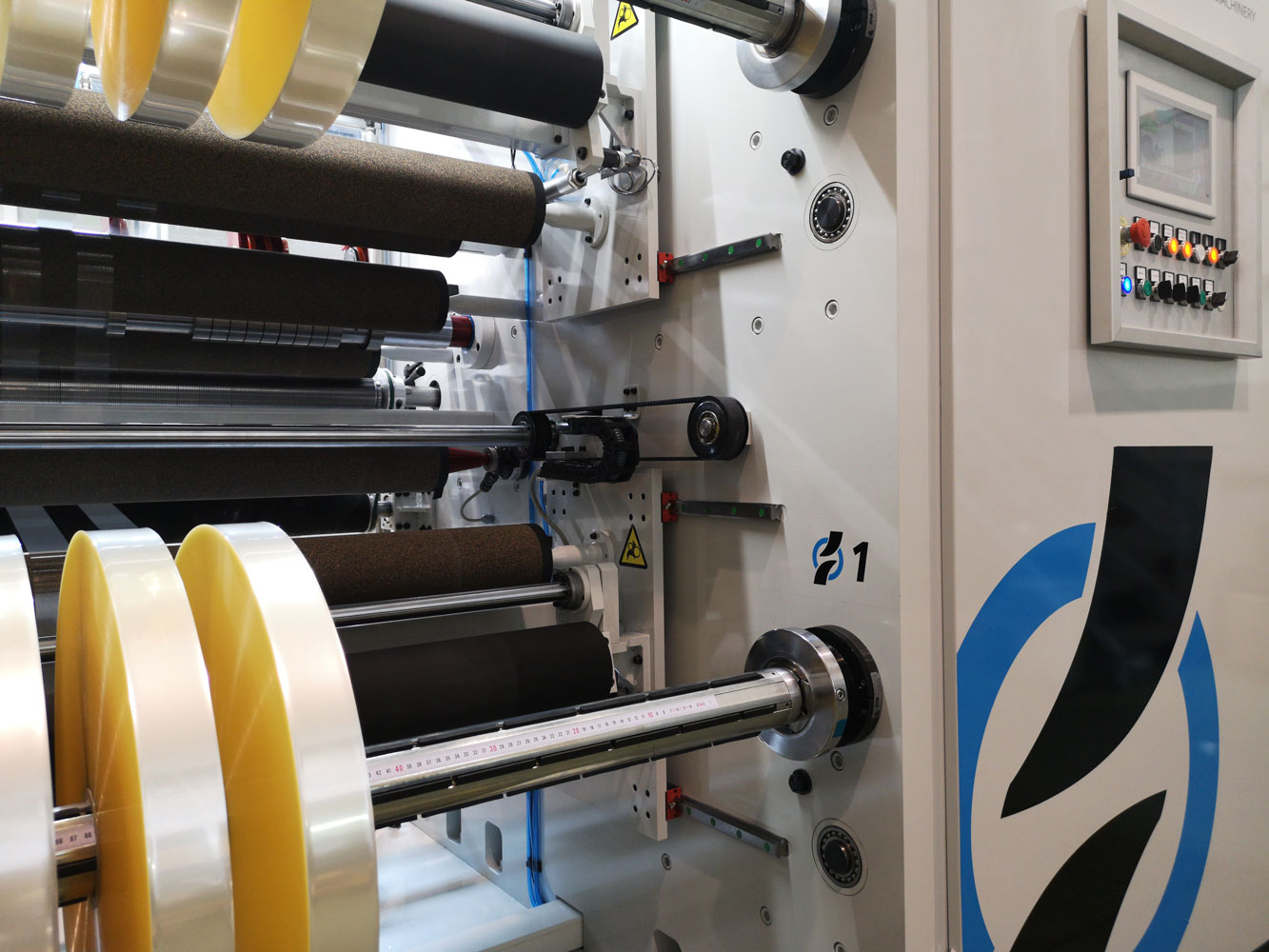
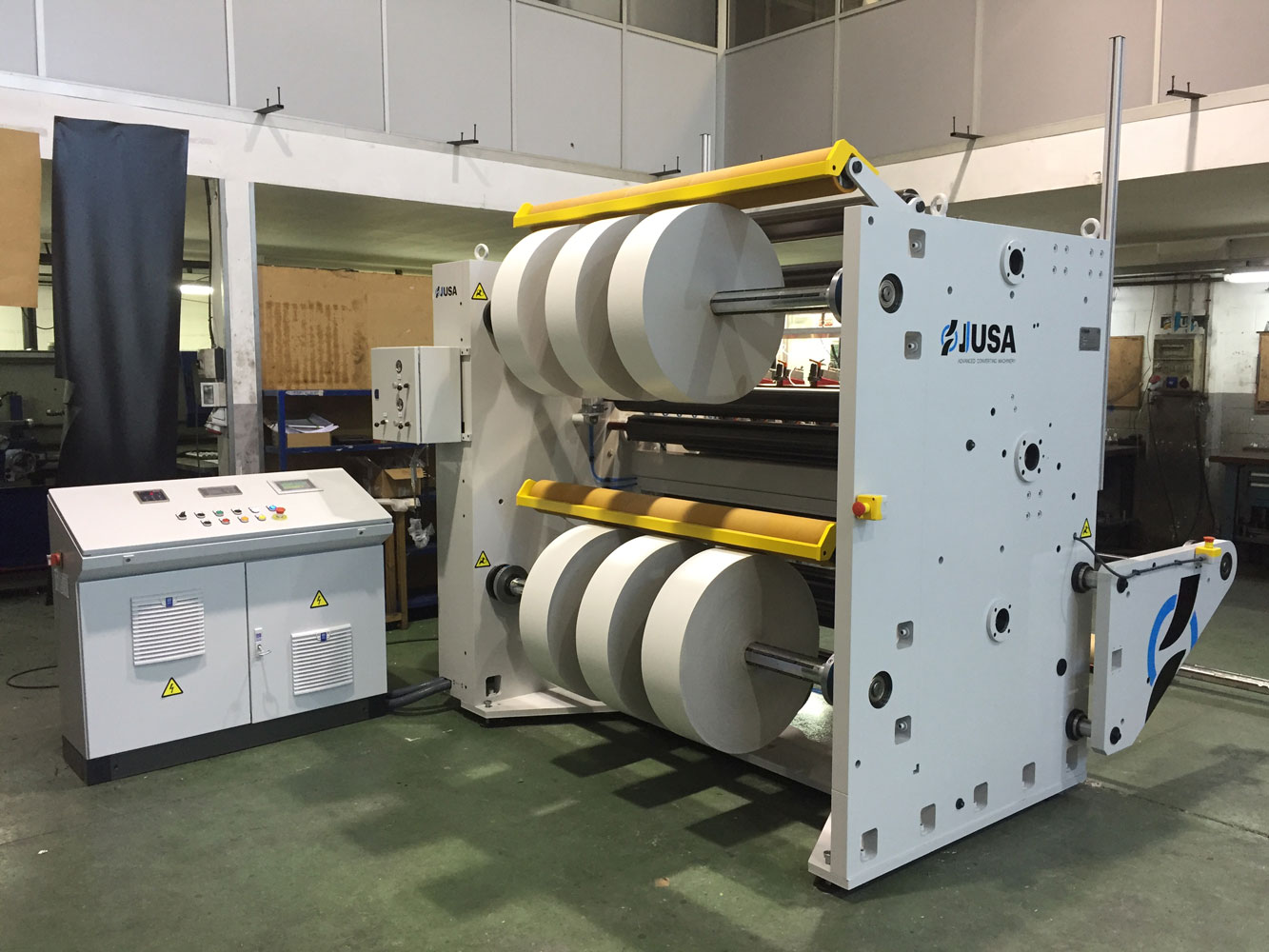
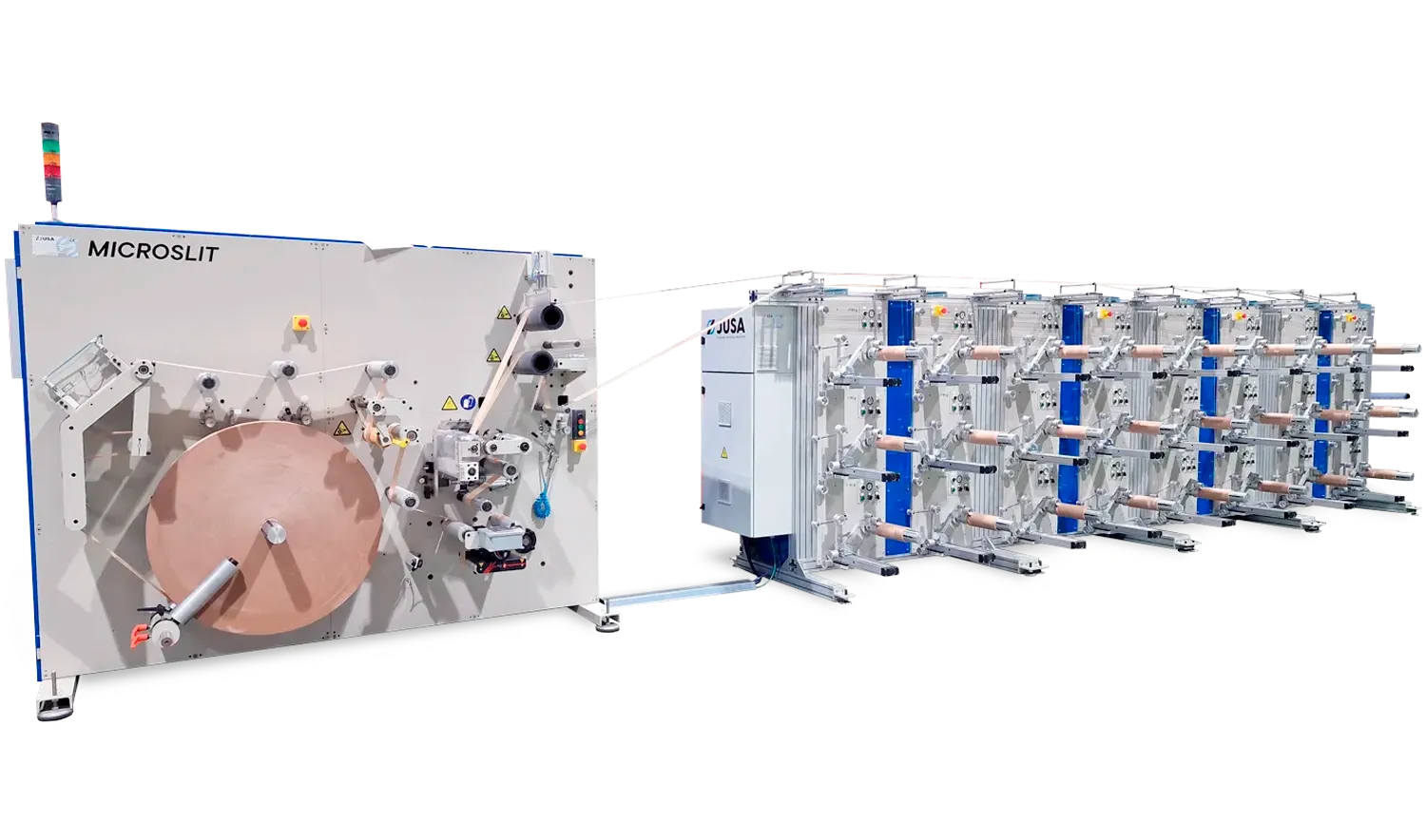
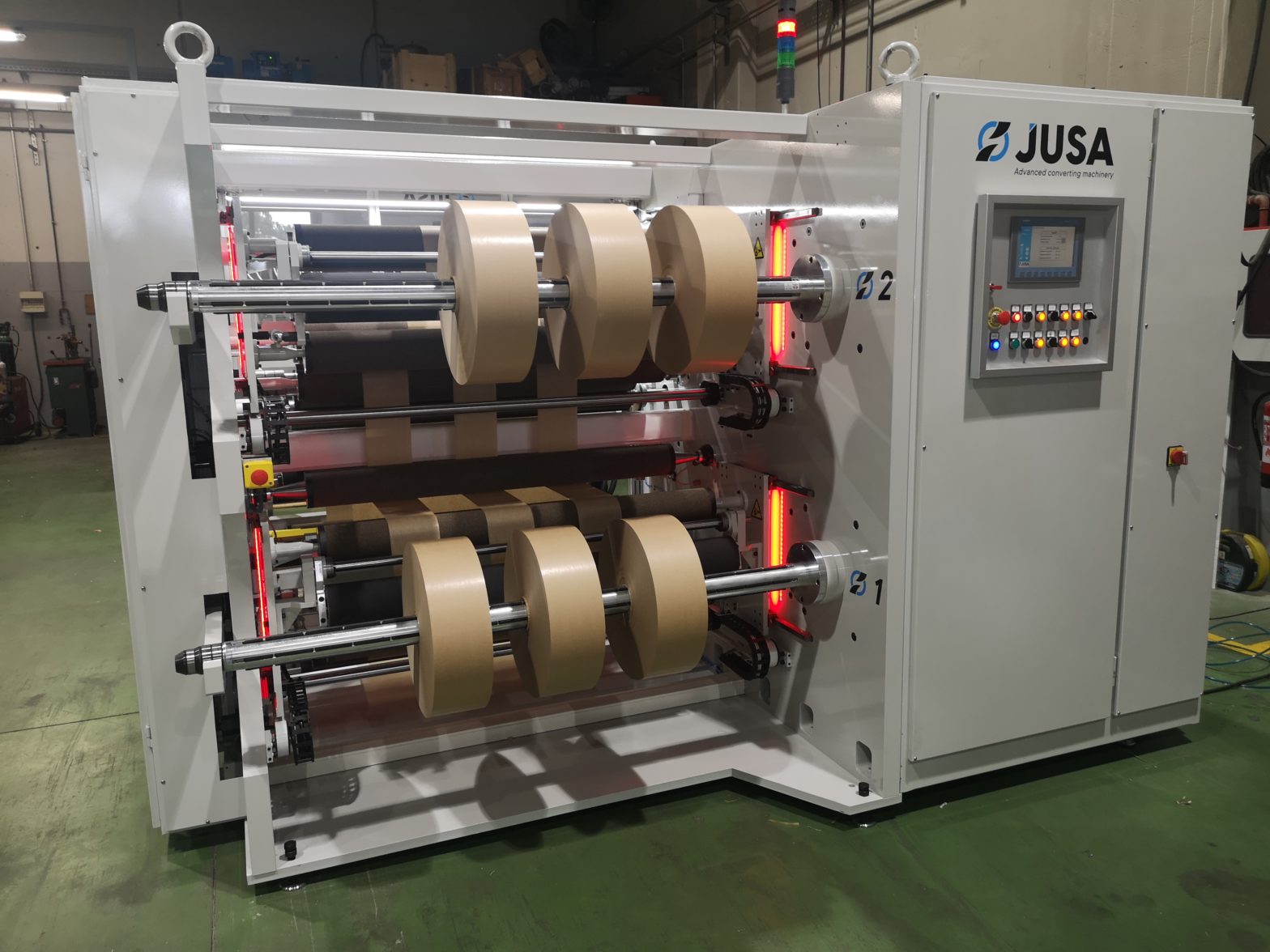
Industrial slitter rewinders can be configured to handle different materials, widths, diameters, and slitting systems according to process requirements.

In high-speed applications, maintaining the right balance between production speed, material stability, and precision is particularly important.

Tension Control in High-Speed Processes

Tension control is one of the fundamental elements in ensuring material stability during converting operations.

Tension must remain within appropriate parameters from unwinding through to rewinding.

Incorrect tension regulation can cause:

  • Material wrinkles.

  • Deformations.

  • Lateral web movement.

  • Variations in roll diameter.

  • Alignment problems.

  • Uneven rewinding.

  • Defects in subsequent processing stages.

As production speed increases, tension variations can have an even greater impact.

For this reason, equipment designed for high-speed production requires systems capable of continuously and precisely adjusting operating parameters.

Stable Rewinding for Uniform Rolls

The purpose of rewinding is not simply to wind the material onto another roll.

The finished roll must meet specific requirements for tension, alignment, winding density, and finish.

A poorly formed roll can be difficult to handle or cause problems when used in another machine.

During high-speed operation, several factors must be controlled:

  • Rewinding torque.

  • Pressure.

  • Tension.

  • Diameter.

  • Speed.

  • Material characteristics.

These parameters may change as the roll diameter increases.

An appropriate control system helps maintain more consistent rewinding conditions throughout the entire cycle.

Automation to Maintain Continuous Production

In high-speed roll converting equipment, automation helps reduce dependence on manual intervention and maintain a more consistent production rate.

It can be used to manage operations such as:

  • Speed control.

  • Tension regulation.

  • Positioning.

  • Format changeovers.

  • Parameter adjustments.

  • Recipe management.

  • Fault diagnostics.

  • Process monitoring.

  • Roll handling.

Automation also improves repeatability.

When the same products are manufactured regularly, saving production parameters helps reduce setup times and retrieve previously used configurations.

Controlled Acceleration and Deceleration

A machine’s maximum speed is not the only factor determining its production capacity.

It is also important to analyze how long the machine takes to reach that speed and how it behaves during acceleration and deceleration.

Sudden speed changes can cause tension variations or affect material stability.

Progressive speed regulation allows the line to accelerate or decelerate while maintaining greater control over the web.

This is particularly relevant in processes involving numerous cycles, roll changes, or stoppages during a single shift.

Reducing Roll Changeover Times

A machine capable of operating at high speed can lose much of its productivity if it needs to stop for extended periods between production runs.

For this reason, changeover times are another factor to consider when evaluating overall performance.

Measures that can help reduce these times include:

  • Simplifying loading and unloading.

  • Automating certain operations.

  • Streamlining adjustments.

  • Using production recipes.

  • Improving accessibility.

  • Integrating auxiliary handling systems.

  • Preparing cores and materials in advance.

Actual productivity depends both on operating speed and on how long the machine remains available for production.

Core Preparation for High-Output Production Lines

Cores must be prepared to the correct dimensions before rewinding begins.

In production lines with frequent changeovers or high output, this operation can become an important part of the workflow.

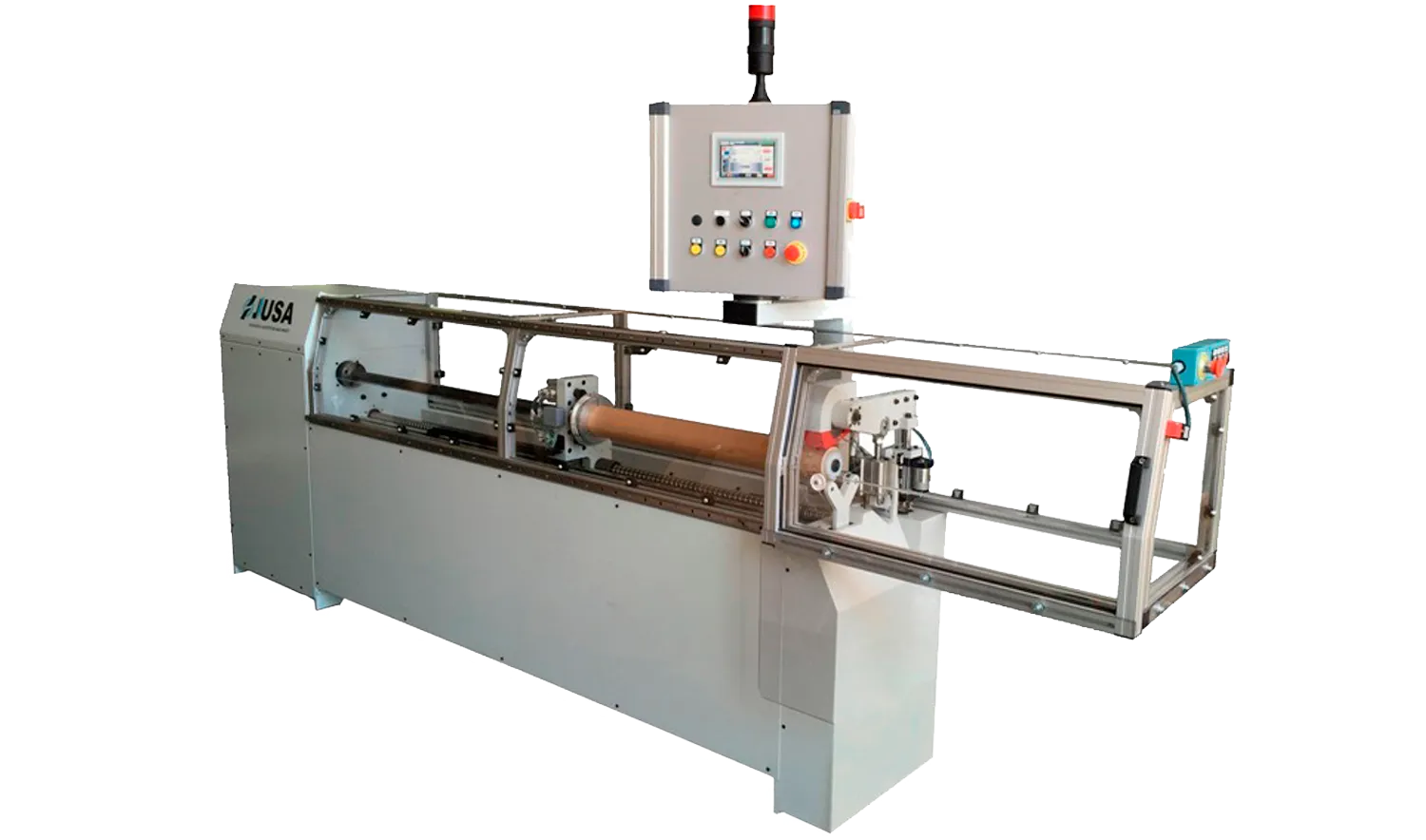
Core cutting machines make it possible to prepare tubes according to the widths required for each production run.

Depending on production volume, this process can be carried out using manual, semi-automatic, or automatic solutions.

Properly integrating core preparation with the rest of the production process helps prevent delays and ensures that cores are available when the line needs them.

Roll Handling in High-Speed Production Lines

As production line capacity increases, so does the volume of rolls that need to be loaded, unloaded, or moved.

For this reason, handling operations should be considered an integral part of the production process.

A high-speed machine can create a new bottleneck if finished rolls cannot be removed quickly enough.

Roll weight, diameter, and dimensions determine which auxiliary systems may be required to facilitate these operations.

Proper integration between the main machinery and handling systems helps maintain a more continuous production flow.

The Importance of the Material Being Processed

Not all materials behave in the same way as production speed increases.

Their physical properties can influence machine configuration and operating limits.

Factors to consider include:

  • Thickness.

  • Elasticity.

  • Rigidity.

  • Sensitivity to tension.

  • Coefficient of friction.

  • Composition.

  • Width.

  • Surface characteristics.

A thin, flexible film may require different settings from paper, laminates, or more rigid technical materials.

Therefore, production speed must be established according to the actual behavior of the material.

High Speed and Quality Must Go Hand in Hand

The objective of a high-speed production line should not simply be to achieve the highest possible number of meters per minute.

Productivity only improves if increased speed is accompanied by appropriate quality levels.

If operating faster leads to more waste, defects, or stoppages, the actual performance improvement may be much smaller than expected.

It is therefore important to find a balance between:

  • Speed.

  • Quality.

  • Stability.

  • Waste.

  • Availability.

  • Safety.

  • Material consumption.

  • Maintenance requirements.

Speed should be analyzed as one variable within the overall performance of the production line.

Maintenance of High-Speed Roll Converting Equipment

Machines operating at high production rates require appropriate maintenance to preserve their precision and reliability.

Wear on certain components can eventually cause vibrations, deviations, or minor performance losses that become more noticeable at higher speeds.

A preventive maintenance program may include inspecting:

  • Mechanical components.

  • Slitting systems.

  • Rollers.

  • Drives.

  • Sensors.

  • Tension control systems.

  • Safety components.

  • Electrical and automation components.

Identifying wear progressively helps reduce the risk of unexpected stoppages and maintain more consistent production conditions.

How to Measure the Performance of a High-Speed Production Line

Maximum speed is only one of the indicators that can be used to evaluate a production line.

It is also useful to analyze:

Average Production Speed

Shows the actual speed at which the machine operates during a shift or an entire production run.

Productive Time

Indicates how long the machine remains in production compared to the total available time.

Downtime

Helps identify losses caused by adjustments, incidents, maintenance, or changeovers.

Changeover Time

Measures how long the line takes to switch from one production run to the next.

Material Waste

Helps determine how much material is lost during adjustments, start-ups, or production.

Product Quality

Analyzes defects, rejected products, or rolls requiring reprocessing.

Production Volume

Makes it possible to compare machine capacity with actual output.

Analyzing several indicators together provides a much more useful overview than simply looking at the machine’s stated maximum speed.

Roll Converting Machinery Tailored to Each Production Process

The requirements of a production line can vary significantly from one company to another.

One operation may require high speed with only a few product specifications, while another may need to combine high operating speeds with numerous formats and frequent changeovers.

Other variables may include:

  • Materials.

  • Working widths.

  • Roll diameters.

  • Slitting systems.

  • Automation levels.

  • Handling requirements.

  • Integration with other equipment.

For this reason, configuring machinery according to the actual process helps prevent individual components from limiting overall production capacity.

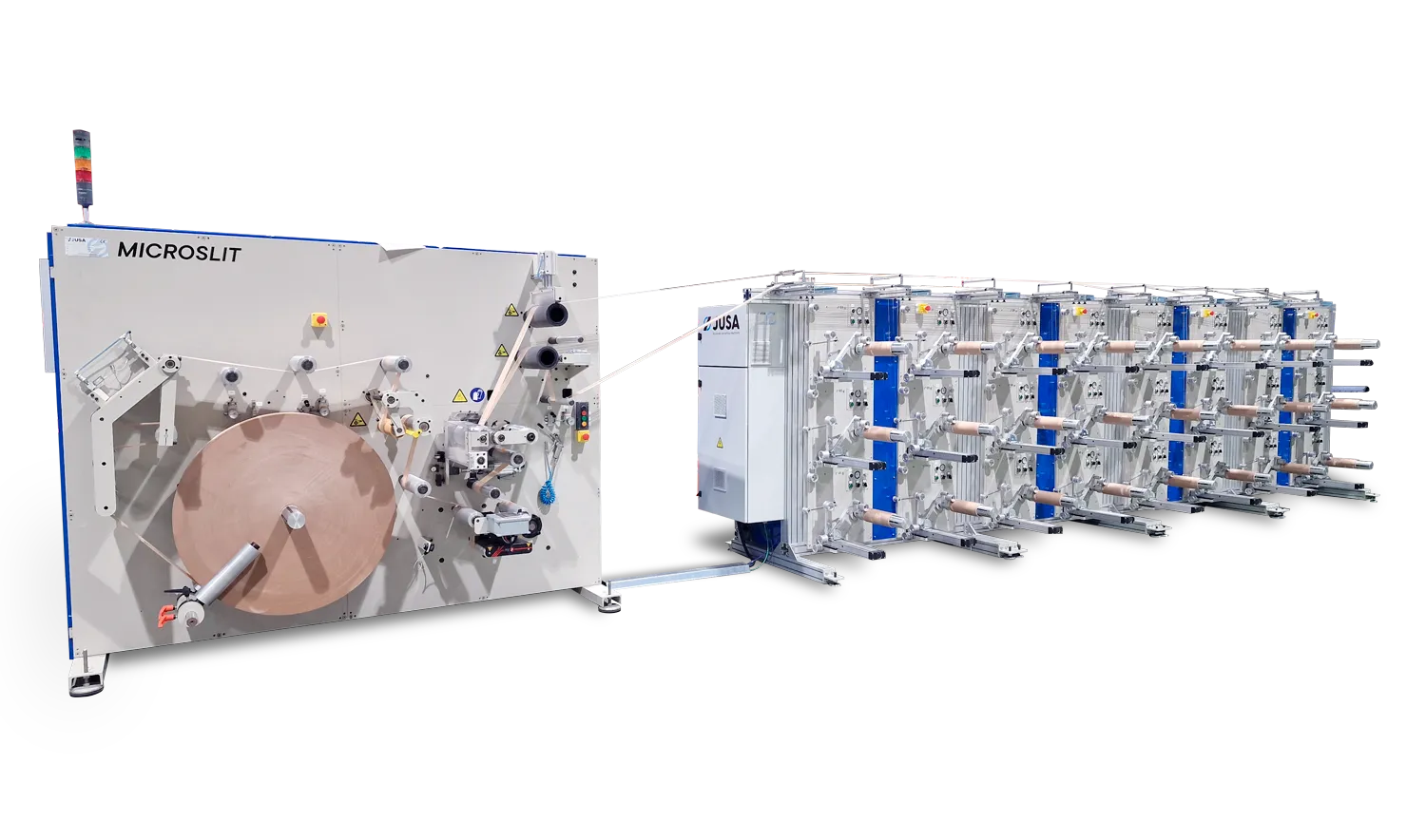
At JUSA Converting, we design and manufacture solutions for slitting, rewinding, core preparation, and other operations involved in processing roll-fed materials, tailored to the specific requirements of each application.

What to Consider When Choosing High-Speed Roll Converting Equipment

Before specifying a new machine, it is important to analyze the entire process rather than focusing solely on the desired operating speed.

Key considerations include:

  1. Materials to be processed.

  2. Minimum and maximum working widths.

  3. Roll diameters.

  4. Required production speed.

  5. Slitting system.

  6. Tension requirements.

  7. Frequency of format changeovers.

  8. Production volume.

  9. Level of automation.

  10. Loading, unloading, and handling requirements.

This information makes it possible to design a solution that better matches actual operating conditions.

Higher Speed Requires Greater Control

High-speed roll converting equipment can significantly increase production capacity, but achieving high operating speeds requires precise control over the entire process.

Slitting, tension control, rewinding, automation, roll changes, and handling must work together in a coordinated way.

The key is not to make a machine run faster for a short period, but to ensure it can maintain a high production rate consistently, repeatably, and with the required quality.

Frequently Asked Questions About High-Speed Roll Converting Equipment

What Is High-Speed Roll Converting Equipment?

It refers to machinery designed to process materials supplied in rolls through operations such as slitting, rewinding, unwinding, or handling, operating at high speeds while maintaining control over the material.

What Factors Limit the Speed of a Roll Converting Line?

Speed may be limited by material type, tension control, the slitting system, rewinding, roll diameter, automation, and handling capacity.

Why Is Tension Control Important at High Speeds?

Because tension variations can cause wrinkles, deformations, lateral movement, or uneven rolls. At high speeds, these deviations can quickly affect a larger quantity of material.

Does Higher Speed Always Mean Greater Productivity?

Not necessarily. Productivity also depends on downtime, format changeovers, waste, quality, and machine availability. Speed must be evaluated alongside these factors.

What Materials Can Be Processed Using High-Speed Roll Converting Equipment?

Depending on the machine configuration, roll-fed materials such as plastic film, paper, aluminum, laminates, and other technical materials can be processed.

Can Roll Converting Equipment Be Customized to Meet the Requirements of Each Production Line?

Yes. Variables such as material type, width, diameter, speed, slitting systems, automation, and handling requirements can determine the configuration needed for each process.
How to Improve OEE in an Industrial Production Line

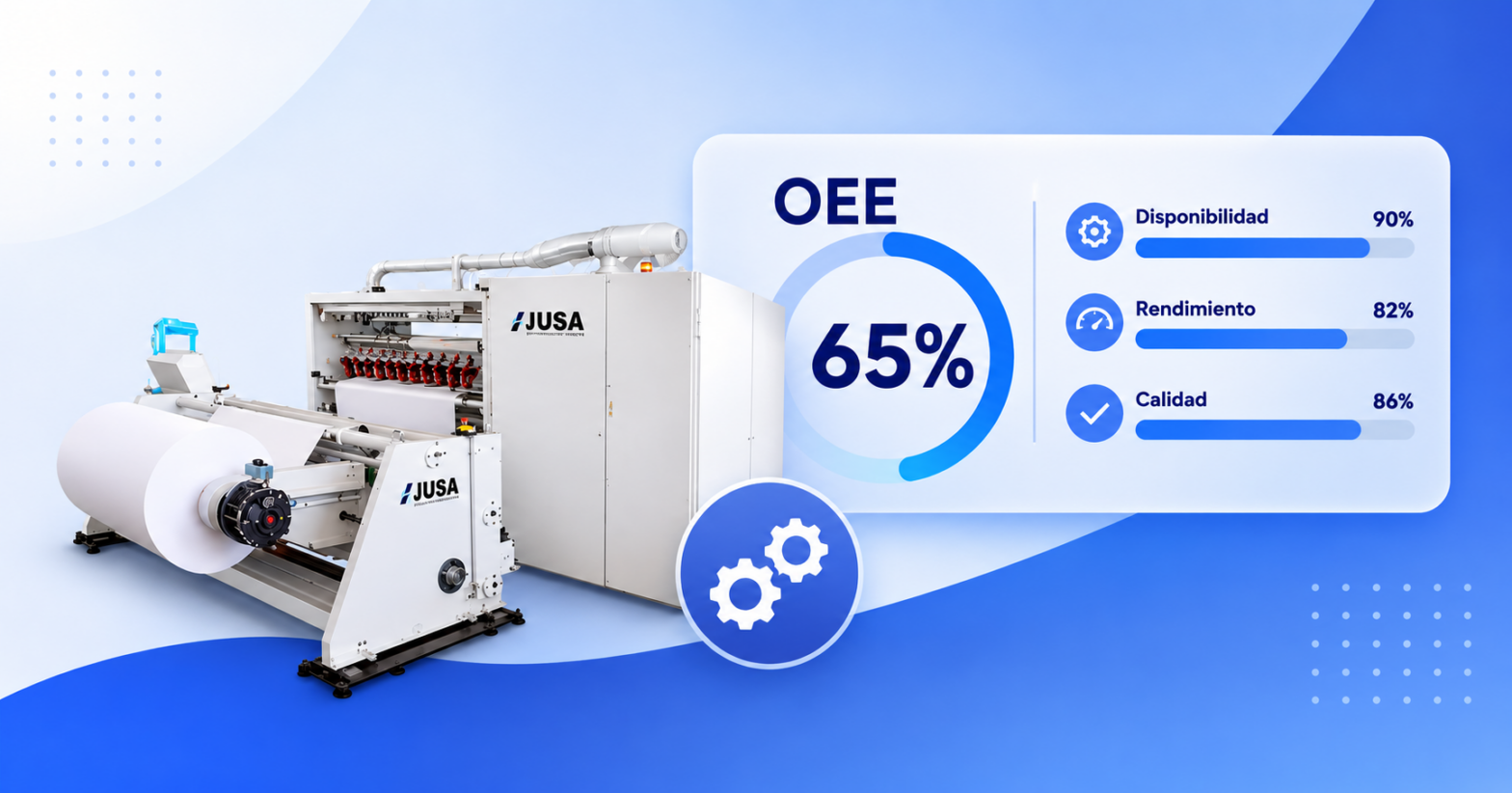
Improving OEE (Overall Equipment Effectiveness) means increasing the actual efficiency of industrial equipment by focusing on three factors: availability, performance, and quality. To achieve this, it is essential to reduce downtime, maintain an appropriate production speed, and minimize defective products.

In sectors such as converting and packaging, an OEE improvement strategy should pay particular attention to roll changes, machine adjustments, tension control, and material waste. Having industrial slitter rewinders tailored to production requirements can help optimize these processes.

However, improving OEE is not simply about installing faster machinery. The real objective is to identify the factors limiting productivity and implement measurable improvements that make better use of existing production capacity.

What Is OEE and Why Is It Important in Industry?

OEE, or Overall Equipment Effectiveness, is a metric used to measure how effectively a machine’s production capacity is utilized during scheduled production time.

This indicator combines three fundamental factors:

  • Availability: measures how long the equipment actually operates compared to the planned production time.

  • Performance: compares actual output with the output that could be achieved at the reference production speed.

  • Quality: determines the proportion of manufactured products that meet the established requirements.

OEE helps identify productivity losses that may otherwise go unnoticed when only the quantity of material produced is analyzed.

For example, a slitter rewinder may operate for most of the working day and still have a low OEE due to frequent minor stoppages, lower-than-expected speeds, or rolls that require reprocessing.

How to Calculate the OEE of an Industrial Machine

The formula used to calculate Overall Equipment Effectiveness is:

OEE (%) = Availability × Performance × Quality × 100

All three factors must be entered as decimal values.

To understand the calculation, consider a slitting and rewinding line with the following results during a working shift:

Indicator Result
Planned production time 480 minutes
Actual operating time 432 minutes
Availability 90%
Performance 85%
Quality 95%

Applying the formula:

OEE = 0.90 × 0.85 × 0.95 × 100 = 72.68%

This means that the line achieves approximately 72.7% overall effectiveness relative to its reference capacity during planned production time.

The result provides a starting point for identifying the main sources of production losses.

There is no universal target value suitable for every facility. Interpretation should take into account the type of machinery, the product, the reference speed, and the characteristics of the process.

Strategies to Improve OEE in a Production Line

An effective strategy must address the actual causes of productivity losses. In a converting line, these losses may be related to format changes, tension adjustments, mechanical issues, or rewinding defects.

1. Reduce Downtime

Downtime is one of the factors that directly affect equipment availability.

In slitting and rewinding processes, stoppages may occur for several reasons:

  • Finished roll changes.

  • Material replacement.

  • Blade adjustments.

  • Web transport system issues.

  • Maintenance operations.

  • Feeding or unwinding problems.

To reduce their impact, it is advisable to record the causes of each stoppage and establish priorities based on their frequency and duration.

Automation can also help reduce certain manual operations.

For example, JUSA Converting’s SR-TURRET automatic slitter rewinder features a dual-turret system, automatic cross-cutting, and automated unloading options.

These features help optimize roll changeover and handling operations, reducing manual intervention during certain stages of the process.

The specific impact on OEE will depend on operating conditions and the downtime recorded before implementing the solution.

2. Optimize Production Speed

Performance is another fundamental component of OEE.

A machine may be available for almost the entire working day but still operate below its reference production capacity.

In converting processes, this situation may be related to:

  • Speeds limited by material characteristics.

  • Incorrect tension settings.

  • Web guiding problems.

  • Frequent minor stoppages.

  • Inefficient machine configurations.

  • Limitations in upstream or downstream processes.

To improve performance, it is important to analyze actual production speed and compare it with an appropriate technical reference for each product.

Increasing speed to the machine’s maximum capacity is not always advisable. If doing so causes defects, material breakage, or additional interruptions, overall effectiveness may decrease.

The optimal speed is the one that maintains a balance between productivity, stability, and quality.

3. Improve Slitting and Rewinding Quality

Quality directly affects OEE because rejected products or those requiring reprocessing reduce usable output.

In flexible material converting, some common defects include:

  • Rolls with uneven tension.

  • Alignment problems.

  • Inaccurate cuts.

  • Wrinkles or material deformation.

  • Edge defects.

  • Rolls that do not meet the required specifications.

To reduce these issues, it is important to control operating parameters and adapt machine settings to the properties of the material.

For example, the SR-2 slitter rewinder incorporates tension control systems and slitting and rewinding solutions designed to handle different materials and formats.

Proper tension regulation can help maintain web stability and reduce winding-related problems.

4. Reduce Setup and Format Changeover Times

In industrial lines that handle different products, changeovers can account for a significant proportion of non-productive time.

Each change in slitting width, material type, or roll diameter may require additional adjustments.

An OEE improvement strategy should analyze these operations to identify which ones can be simplified.

Recommended actions include:

  1. Standardize format changeover procedures.

  2. Prepare tools and materials before stopping the machine.

  3. Identify adjustments that can be performed externally and safely.

  4. Improve positioning and configuration systems.

  5. Measure the time required to complete each changeover.

These measures are related to the SMED methodology, which focuses on reducing equipment setup times.

5. Implement Preventive Maintenance

Unexpected breakdowns affect availability and can lead to significant production losses.

For this reason, improving OEE requires combining production data analysis with an appropriate maintenance strategy.

Some useful actions include:

  • Regularly inspect mechanical components.

  • Check the condition of blades and cutting elements.

  • Verify tension and web transport systems.

  • Inspect sensors and control devices.

  • Record recurring incidents.

  • Schedule maintenance according to the manufacturer’s recommendations.

Preventive maintenance helps identify certain problems before they cause a stoppage, although it must be adapted to actual operating conditions.

What Is the Relationship Between Industrial Automation and OEE?

Automation can improve the performance of an industrial production line by reducing manual intervention, simplifying certain operations, and maintaining more precise control over production parameters.

In converting lines, these improvements can be applied to unwinding, slitting, roll changes, and rewinding.

Potential benefits include:

Greater Production Continuity

Automated systems can reduce the time required to perform certain repetitive operations.

Control of Operating Parameters

Tension regulation and web guiding systems help maintain more stable operating conditions.

Reduction of Operational Errors

Automating specific operations can limit certain variations associated with manual adjustments.

Better Utilization of Machine Capacity

Integrating different operations can reduce non-productive time when the process is properly designed and configured.

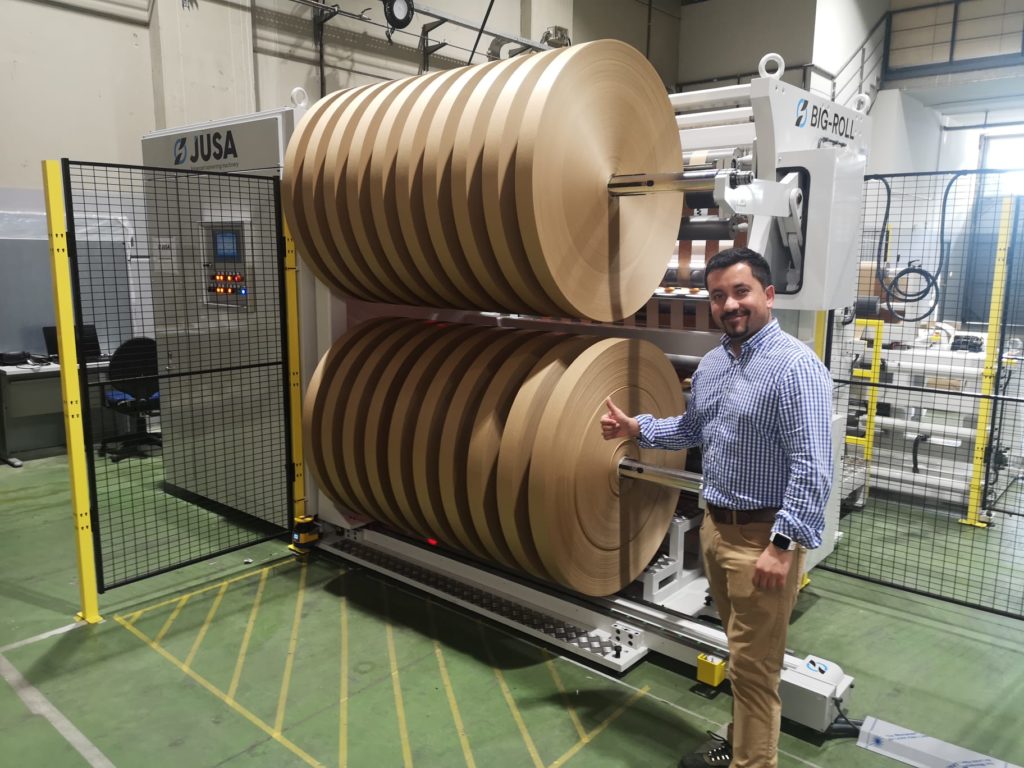
For example, in facilities handling large-diameter rolls, the JUSA Converting SR-BIG ROLL offers solutions for slitting and rewinding large-format materials, featuring automatic tension control and process regulation systems.

However, automation must address an identified need. Introducing new technologies without analyzing existing losses does not guarantee an improvement in OEE.

How to Implement an OEE Improvement Strategy Step by Step

To achieve measurable results, it is advisable to follow a structured process.

Step 1. Measure the Initial Situation

Collect information on availability, production speed, and products that meet quality requirements.

It is important to use consistent criteria so that results can be compared across different periods.

Step 2. Identify the Main Losses

Classify incidents according to whether they affect availability, performance, or quality.

For example, a stoppage caused by a roll change affects availability, while operating below the reference speed affects performance.

Step 3. Prioritize the Most Significant Causes

Not all incidents have the same impact.

Analyze which ones cause the greatest losses and prioritize those that can be addressed in a technically and economically feasible way.

Step 4. Implement Specific Improvements

Actions may include configuration adjustments, maintenance, staff training, operational reorganization, or automation of certain processes.

Step 5. Evaluate the Results

After implementing an improvement, recalculate OEE using the same measurement criteria.

This will help determine whether the intervention has delivered a measurable benefit.

Practical Example of OEE Improvement in a Slitter Rewinder

Consider a slitting and rewinding line with the following indicators:

Indicator Initial Situation Improved Situation
Availability 85% 92%
Performance 80% 88%
Quality 95% 97%
OEE 64.6% 78.5%

In this hypothetical example, the improvements include reduced roll changeover times, greater operating speed stability, and fewer rejected products.

The result would be an approximate increase of 13.9 percentage points in OEE.

This scenario is illustrative and does not represent actual data from a JUSA Converting installation.

Its purpose is to demonstrate that small, combined improvements in availability, performance, and quality can have a considerable impact on overall equipment effectiveness.

What Mistakes Should You Avoid When Trying to Improve OEE?

An improvement strategy can become less effective when it focuses solely on increasing production without analyzing the underlying causes and consequences.

Some of the most common mistakes include:

  • Measuring speed alone: producing faster does not guarantee greater efficiency if defects increase.

  • Ignoring minor stoppages: brief, frequent interruptions can account for considerable losses.

  • Failing to distinguish production times: it is essential to correctly define which periods are included in the calculation.

  • Comparing different machines without context: their capacities and production conditions may vary.

  • Implementing improvements without measuring results: without comparable indicators, it is difficult to assess their effectiveness.

The specialized website OEE.com explains the six major production losses and their relationship with the three OEE components, providing a useful framework for classifying incidents and prioritizing improvements.

Improve Your Process Efficiency with JUSA Converting

Improving OEE requires understanding how each stage of production operates, identifying the main sources of losses, and selecting technical solutions tailored to the process.

In converting lines, slitting, unwinding, and rewinding systems play a fundamental role in production continuity, operating speed, and finished material quality.

At JUSA Converting, we develop machinery for processing flexible materials, offering slitting and rewinding solutions tailored to different industrial requirements.

From high-output automated systems to equipment designed to handle different roll diameters and formats, our goal is to provide solutions that help improve process efficiency and reliability.

Explore our industrial slitter rewinders and contact our team to find the most suitable solution for your production line.

Frequently Asked Questions About Improving OEE

What Does OEE Mean in Manufacturing?

OEE stands for Overall Equipment Effectiveness. It is a metric that combines availability, performance, and quality to evaluate a machine’s production effectiveness.

What Is a Good OEE Percentage?

It depends on the industry, machinery, and production conditions. Although 85% is commonly used as a general benchmark, it should not be considered a universal target. The important thing is to analyze the initial situation and establish realistic goals.

How Can OEE Be Improved Quickly?

The first step is to identify the main productivity losses. Reducing recurring stoppages, optimizing format changeovers, and correcting quality issues can lead to improvements without replacing all existing machinery.

What Is the Difference Between OEE and Productivity?

Productivity relates output to the resources used. OEE specifically measures equipment effectiveness through availability, performance, and quality. Both indicators are related, but they do not measure exactly the same thing.

How Does Maintenance Affect OEE?

Maintenance helps reduce breakdowns and unexpected stoppages, primarily improving machine availability. It can also help maintain stable operating conditions that support performance and quality.

Does Automation Always Improve OEE?

Not necessarily. Automation can reduce non-productive time and improve process control, but its effectiveness depends on addressing actual production losses and being properly integrated into the production line.

How to Improve the Efficiency of a Slitter Rewinder

Improving the efficiency of a slitter rewinder is not simply about increasing machine speed. An efficient production line must maintain a stable production flow, reduce downtime, minimize waste and ensure consistent quality.

To achieve this, it is essential to identify which operations slow down production, measure their impact and implement targeted improvements. In converting lines for packaging applications, particular attention must be paid to equipment availability, roll handling and coordination between the different operations.

How to Identify Efficiency Losses in a Slitter Rewinder

A production line can operate at high speed and still produce less than expected. This happens when part of the available production time is lost due to stoppages, adjustments, manual interventions or incidents that reduce actual output.

Before considering any improvements, it is important to identify the signs that the process is not operating at its full potential.

Identified Problem Possible Cause What to Check
Lower-than-expected output Frequent stoppages or long cycle times Equipment availability and performance
Accumulation of finished rolls Slow unloading or handling Unloading systems and workflow organization
Long changeover times Repetitive manual adjustments Procedures and automation opportunities
Rejected rolls Slitting, tension or rewinding defects Process parameters and product quality
Unexpected interruptions Breakdowns or component wear Machine condition and preventive maintenance

This assessment helps distinguish capacity-related problems from availability or quality issues. Not every problem requires an investment in new machinery: sometimes, reorganizing an operation or upgrading a component can have a significant impact.

5 Steps to Improve Slitter Rewinder Efficiency

Once performance losses have been identified, it is important to establish a clear improvement plan. These five measures provide a progressive approach to optimizing production and determining which actions deliver the greatest value.

1. Analyze Actual Production Performance

The first step is to determine how much the production line actually produces compared to its expected capacity.

Checking the machines’ nominal operating speed is not enough. Operating hours, downtime and the quantity of finished products meeting quality requirements must also be recorded.

For example, a slitter rewinder may operate at its intended slitting speed but lose a considerable portion of each shift during unloading and preparation operations. In this situation, increasing its maximum speed would have a limited effect on daily output.

2. Improve Roll Management and Handling

Material feeding and finished roll removal can significantly influence production rates, particularly when handling large-diameter rolls, heavy rolls or frequent production cycles.

To improve these operations, it is advisable to review:

  • Time required to load parent rolls.

  • Frequency of roll changes.

  • Ease of finished roll removal.

  • Movements and handling operations performed by operators.

  • Availability of sufficient space and suitable equipment for subsequent operations.

Efficient management of these tasks helps reduce unproductive time and allows machinery to maintain a more consistent operating pace.

3. Incorporate Auxiliary Equipment When Necessary

In some facilities, the main bottleneck is not the primary machine but the operations performed before or after it.

Auxiliary equipment for production lines can improve specific operations without requiring the replacement of existing machinery.

At JUSA Converting, we develop different solutions, including:

  • Automatic and semi-automatic roll unloading systems.

  • Slitting units with automatic knife positioning.

  • Web guiding and tension control systems.

  • Splicing tables and other equipment integrated into converting lines.

For example, an automatic roll unloading arm can facilitate the removal of finished rolls and reduce manual intervention during this operation.

However, when the main problem involves width adjustments, a slitting unit with automatic knife positioning may provide greater benefits.

The most suitable solution will always depend on the specific problem that needs to be addressed.

4. Prevent Problems Through Proper Maintenance

Efficiency also depends on machinery maintaining stable operating conditions over time. Component wear, incorrect adjustments and mechanical failures can cause interruptions that directly affect production.

A preventive maintenance program tailored to the equipment should include inspections of cutting components, drive systems, mechanical elements and control devices.

In addition to reducing the risk of unexpected breakdowns, these measures help identify potential deviations before they affect finished roll quality.

5. Measure Results and Adjust the Process

The final step is to evaluate whether the implemented changes are delivering measurable improvements.

To do this, it is important to compare the same performance indicators across equivalent production periods and, whenever possible, under similar operating conditions.

Particular attention should be paid to usable production output, unplanned downtime and time spent on operations that do not directly convert material.

Continuous improvement makes it possible to introduce gradual adjustments without relying exclusively on major investments or complete machinery replacements.

Which Indicators Help Measure Production Efficiency?

Any improvement should be evaluated using objective data.

One of the most widely used indicators in industrial environments is OEE (Overall Equipment Effectiveness), which combines equipment availability, performance and quality.

However, efficiency should not be assessed through a single indicator. Each facility should select the metrics that best reflect its operating conditions.

Indicator What It Measures
Availability The proportion of planned production time during which the machine is actually operating
Performance How actual production compares with expected capacity
Quality The percentage of production that meets established quality requirements
Changeover time Time required to prepare the machine for a new product or format
Material waste The proportion of raw material lost during production

These indicators help connect observed problems with their possible causes and establish improvement priorities.

Practical Example: Increasing Output Without Increasing Speed

Imagine a slitter rewinder operating during an eight-hour shift. Although its slitting capacity is sufficient, unloading operations frequently require production to stop.

Consider the following hypothetical scenario:

  • 20 unloading operations per shift.

  • 5 minutes required for each operation.

  • An improved procedure that reduces unloading time to 3 minutes.

Under these conditions, total unloading time would decrease from 100 to 60 minutes per shift.

This would recover 40 minutes of potential machine availability without changing the slitting speed.

The actual increase in production would depend on whether the machine can make use of this additional time and whether other process limitations exist.

This example illustrates an important principle: improving packaging line efficiency can depend more on reducing unproductive operations than on increasing machine speed.

When Should You Upgrade a Slitter Rewinder?

Not all improvements can be achieved through organizational changes.

When limitations are related to equipment capacity, material characteristics or available machine features, it may be necessary to consider a technological upgrade.

At JUSA Converting, we manufacture different configurations of slitter rewinders adapted to specific production requirements.

These include the SR-TURRET, an automatic dual-turret slitter rewinder designed for high-volume production and equipped with systems that automate roll changes.

We also offer solutions such as the SR-BIG ROLL, designed to process large-diameter rolls.

Machine selection must be based on the actual requirements of each facility, considering material type, production formats, expected output and integration possibilities.

In certain cases, existing installations can also be improved by incorporating auxiliary equipment or upgrading specific machine systems.

Greater Efficiency Starts with Process Analysis

The efficiency of a packaging production line depends on its ability to maintain stable output, minimize interruptions and make effective use of available resources.

Achieving this requires identifying actual performance losses and focusing on the operations that have the greatest impact on productivity.

At JUSA Converting, we design and manufacture machinery for roll material converting, offering slitting, rewinding and auxiliary equipment solutions adapted to different industrial applications.

Our technical expertise allows us to analyze the requirements of each process and recommend machine configurations that help improve productivity and converted material quality.

Frequently Asked Questions

How Do You Calculate the Efficiency of a Slitter Rewinder?

Slitter rewinder efficiency can be evaluated using indicators such as availability, performance and quality.

OEE combines these three factors to provide an overall assessment of equipment efficiency.

It is also important to analyze changeover times, production stoppages and the quantity of finished products that meet quality requirements.

What Commonly Causes Productivity Losses in a Converting Line?

Common causes include unplanned downtime, lengthy loading and unloading operations, format changeovers, quality problems and capacity limitations in specific equipment.

Identifying the frequency and duration of these issues helps prioritize improvement measures.

Can Efficiency Be Improved Without Replacing Existing Machinery?

Yes. In certain facilities, incorporating auxiliary systems, improving operating procedures, implementing preventive maintenance or upgrading components can increase productivity without replacing the entire production line.

What Are the Benefits of Automating Roll Unloading?

Automatic roll unloading systems can reduce the time and manual intervention required to remove finished rolls.

Their impact depends on roll weight and format, production cycle frequency and how the manufacturing process is organized.

What Are the Benefits of an Automatic Knife Positioning System?

Automatic knife positioning systems allow cutting blades to be positioned quickly and accurately, reducing setup times and manual adjustments.

Their impact depends on the number of production formats, the frequency of job changeovers and the precision requirements of the manufacturing process.

Packaging Process Optimization: How to Improve Production Efficiency

Packaging process optimization helps improve productivity, reduce waste and minimize downtime in production lines that handle plastic films, paper, aluminum foil, laminates and other flexible materials used in packaging manufacturing.

It is not simply about increasing production speed. Efficiency depends on the coordination of operations such as slitting, rewinding, core preparation, format changeovers and roll handling.

What Does Packaging Process Optimization Mean?

Optimizing a packaging process involves analyzing each stage of the production line to identify where time, material or production capacity is being lost.

In the converting industry, optimization focuses particularly on transforming material rolls into the formats required for subsequent manufacturing stages.

Some of the main aspects to evaluate include:

  • Production speed and actual equipment performance.

  • Slitting precision.

  • Tension control and web stability.

  • Roll changes and loading and unloading operations.

  • Core preparation.

  • Automation of repetitive operations.

  • Machine downtime and adjustments.

  • Material waste and finished roll quality.

The objective is to achieve a more stable, repeatable process adapted to actual production requirements without compromising the quality of the converted material.

Identifying Production Line Bottlenecks

Before investing in new machinery or automation, it is important to understand which part of the process is actually limiting production.

For example, increasing the speed of a slitter rewinder will not improve overall efficiency if the next stage cannot handle the additional output or if loading, unloading and core preparation operations cause frequent downtime.

Key questions to analyze include:

  • Which operations take the most time?

  • Where do most production stoppages occur?

  • Which tasks depend heavily on manual intervention?

  • Which format changeovers slow down production?

  • At which stages is the most material waste generated?

It is also important to distinguish between planned downtime, such as format changeovers, and unplanned downtime caused by breakdowns or winding-related problems.

This analysis makes it possible to prioritize improvements with the greatest impact on the overall productivity of the production line.

Slitting and Rewinding in Packaging Optimization

In many converting lines, slitting and rewinding are critical stages in preparing materials for packaging applications.

Industrial slitter rewinders transform parent rolls into narrower rolls or formats adapted to subsequent processes while maintaining control over parameters such as slitting width, web tension, final roll diameter and rewinding quality.

Incorrect machine settings can cause wrinkles, lateral displacement, uneven rolls or increased material rejection.

They can also result in rolls with unsuitable hardness, instability between layers or difficulties during handling and subsequent processing.

Optimizing this stage therefore requires a coordinated approach to the slitting system, web tension and rewinding conditions, taking into account material characteristics, roll diameters and the required finished product quality.

The choice of winding system, whether center winding, surface winding or combined center-surface winding, also affects roll formation and must be adapted to each application.

The Importance of Proper Core Preparation

The cores or tubes onto which the material is rewound also influence process stability.

Incorrect core lengths, imprecise cutting or slow preparation can cause problems during rewinding, affect roll formation and increase downtime between production runs.

Core cutting machines prepare cardboard tubes and other compatible materials according to the dimensions required for each format. Manual, semi-automatic and automatic solutions are available, depending on tube characteristics and production volume.

For example, when a slitter rewinder processes rolls of different widths, having cores pre-cut to the correct length facilitates format changeovers and prevents interruptions caused by a lack of prepared cores.

Automating this stage can help reduce preparation times and improve cutting repeatability, particularly in facilities with high core consumption.

Reducing Changeover Times

Packaging and converting lines frequently process different widths, materials and formats.

Each changeover may require adjustments to blade positions or types, tension settings, cores, rewinding shafts or machine configurations.

Several measures can help reduce these times:

  • Save production recipes on machines equipped with this functionality.

  • Simplify adjustments and standardize the most frequently used configurations.

  • Automate repetitive parameter adjustments.

  • Facilitate tool positioning through systems such as automatic knife positioning.

  • Standardize preparation, loading and unloading procedures.

When numerous changeovers are performed during a single shift, saving just a few minutes on each one can significantly improve overall productivity.

It is also advisable to prepare cores and other necessary components before stopping the machine, provided operating and safety conditions allow it.

Automation: When Does It Add Value?

Automation plays an important role in packaging process optimization, particularly when it reduces unproductive time, improves repeatability and facilitates production operations.

Automation can be applied to tasks such as:

  • Roll loading and unloading.

  • Slitting and knife positioning.

  • Rewinding and automatic roll changes.

  • Core preparation.

  • Regulation of tension, speed and other operating parameters.

  • Material handling.

Depending on equipment configuration, these solutions can reduce certain manual interventions and maintain more stable production conditions.

For example, slitter rewinders equipped with automatic turret systems can facilitate roll changes and reduce the interruptions associated with this operation.

Similarly, auxiliary equipment such as roll unloading systems or automatic knife positioning systems can help optimize specific stages of the process.

However, more automation does not always mean better productivity.

The appropriate level depends on production volume, format variety and changeover frequency. A highly flexible production line may require a different solution from a facility dedicated to long, continuous production runs.

Before implementing automation, it is therefore essential to evaluate potential time savings, reduced manual intervention and the investment required for each solution.

Measuring the Effectiveness of Process Optimization

Improvements should be assessed using objective performance indicators.

Some of the most useful KPIs include:

  • Cycle time and actual production output per hour or shift.

  • Planned and unplanned downtime.

  • Percentage of material waste relative to total material processed.

  • Format changeover time.

  • Productivity per shift and equipment availability.

  • Number of rejected or reprocessed rolls due to slitting or rewinding defects.

Another useful indicator is OEE (Overall Equipment Effectiveness), which combines availability, performance and quality to evaluate overall equipment efficiency.

Comparing these values before and after implementing an improvement makes it possible to determine whether production line efficiency has actually increased.

For example, if a slitter rewinder operates at a good production speed but frequently stops to unload finished rolls, analyzing unloading times may reveal a greater improvement opportunity than increasing slitting speed.

Machinery Adapted to the Production Process

One of the most important aspects of packaging process optimization is avoiding situations where the entire production process must adapt to the limitations of a standard machine.

Variables such as material type, thickness, web width, unwinding and rewinding diameters, operating speed and level of automation can vary significantly between manufacturing facilities.

At JUSA Converting, we design and manufacture machinery solutions for slitting, rewinding and core preparation, adapted to different industrial requirements.

Our technical team analyzes material characteristics, production conditions and the specific requirements of each facility to define the most suitable machine configuration.

We also provide technical consulting and maintenance services to help improve the performance of both new and existing equipment.

The key is to analyze the entire process and select technology based on actual production requirements.

Looking to improve the efficiency of your converting line? Contact our technical team to explore solutions that can help reduce downtime, optimize resources and improve finished roll quality.

Frequently Asked Questions

Where Should You Start When Optimizing Packaging Processes?

Start by analyzing downtime, production bottlenecks, material waste, format changeovers and manual operations that affect productivity.

In converting processes, it is also important to evaluate slitting quality, rewinding stability and roll loading and unloading times.

How Does Tension Control Affect Production Efficiency?

Incorrect web tension can cause wrinkles, deformation, material displacement and rewinding problems.

Maintaining tension within the appropriate range for each material improves process stability and helps reduce rejected rolls caused by winding defects.

Does Automation Always Improve Productivity?

Not necessarily. Automation must be adapted to production volumes, format variety and the overall operation of the production line to deliver measurable improvements.

It is important to identify the operations responsible for the greatest time losses before determining which level of automation offers the best return on investment.

Is It Necessary to Replace All Machinery to Optimize the Process?

No. In many cases, performance can be improved by adjusting operating parameters, automating specific operations, upgrading components or eliminating particular bottlenecks.

Adding auxiliary equipment, implementing preventive maintenance or modernizing selected systems can also help improve the performance of existing machinery.

What Is a Spooling Machine and What Is It Used For?

A forwarder is an industrial machine designed to wind continuous material onto a spool, core or mandrel in a controlled and orderly manner, producing a finished spool.

Unlike a conventional rewinder, which typically converts one roll into another, a forwarder is specifically designed to collect continuous material and distribute it transversely across a spool.

The material is wound as the spool rotates, while a relative transverse movement takes place between the material and the spool. Combining these two movements ensures uniform winding and makes full use of the available spool width.

Forwarders are used to produce spools of many continuous products, including cables, wires, adhesive tapes, packaging materials, films, fibers, technical textiles and other industrial products.

What Is a Spool?

A spool consists of a core and, typically, two side flanges between which continuous material is wound.

The objective is to create a compact format that allows a specific length of material to be stored, transported and subsequently used in a controlled manner.

Depending on the application, the core may be made of cardboard, plastic, wood or metal, while its dimensions are adapted to the product and the quantity of material it needs to hold.

The winding must be sufficiently uniform and stable to ensure that the material can later be unwound without shifting, tangling or damage.

How Does a Forwarder Work?

The operating principle of a forwarder is straightforward, although it requires precise coordination between several movements.

Continuous material reaches the winding station and is fed onto the spool. As the spool rotates, the material moves transversely from side to side.

When the material reaches one end of the spool, it reverses direction and continues forming successive layers. This distributes the product evenly across the usable width of the spool.

To achieve high-quality winding, the machine must primarily synchronize:

  • Spool rotational speed.

  • Transverse movement.

  • Material feed speed.

  • Winding tension.

  • Increasing spool diameter.

  • Length of material to be wound.

The relationship between spool rotation and transverse movement determines the traverse pitch and, consequently, how the material is distributed across the spool.

Two Types of Forwarders

Forwarders can be classified according to several criteria, including which component performs the transverse movement.

1. Forwarders with a Moving Material Guide

In this type of machine, the spool remains in a fixed position while a material guide or traverse arm moves transversely.

The guide directs the material from one side of the spool to the other, controlling its position during winding.

The transverse movement is synchronized with the spool’s rotational speed to achieve the required winding pitch and pattern.

This system makes it easy to adapt the traverse movement to different spool widths and formats.

2. Forwarders with a Moving Spool

In this configuration, the incoming material guide can remain stationary while the spool, mandrel or entire winding assembly moves transversely.

The operating principle remains the same: there must be relative movement between the material and the spool to distribute the product across its full width.

Choosing between these configurations depends on factors such as material type, spool width and weight, production speed and the specific requirements of the application.

Mechanical and Electronic Forwarders

Forwarders can also be distinguished by the technology used to control transverse movement and synchronize it with spool rotation.

1. Mechanical Forwarders

Traditional machines used mechanical mechanisms to establish the relationship between spool rotation and transverse movement.

Gears, cams, lead screws and other transmission components were used to control the winding pitch.

This system can be suitable for applications involving long production runs of the same product with few format changes.

However, modifying the winding width, pitch or pattern may require mechanical adjustments or component replacements.

2. Electronic Forwarders

Advances in electric drives and control systems have enabled the development of electronic forwarders, in which movements are synchronized through motors and programmable control systems.

This technology offers greater flexibility and allows winding parameters to be modified directly through the control system without requiring mechanical changes.

Its main capabilities include:

  • Programmable winding pitch.

  • Precise control of transverse movement.

  • Electronic synchronization between different drives.

  • Tension control.

  • Storage of different spool configurations.

  • Rapid changeovers between products.

  • Automation of different stages of the process.

For these reasons, although mechanical solutions can still be found in highly specific applications, electronic technology has progressively become the preferred solution in modern industrial forwarders.

Which Industries Use Forwarders?

Forwarders are used in processes where continuous material needs to be converted into a compact spool ready for handling or subsequent use.

Cable Industry

Cable manufacturing is one of the most common applications.

Forwarders can produce spools of:

  • Electrical cables.

  • Data cables.

  • Telecommunications cables.

  • Coaxial cables.

  • Fiber optic cables.

  • Wires and conductors.

  • Specialty cables.

The spool makes it possible to store and transport long lengths of material while facilitating its subsequent feeding into other processes.

Adhesive Tape Manufacturing

Adhesive tapes are another important application of forwarder technology.

Adhesive materials can be traverse-wound to produce long-length spools intended for subsequent cutting, application or assembly processes.

Applications include single-sided tapes, double-sided tapes, foam tapes and various types of technical adhesive tapes.

Packaging and Converting

In the packaging and converting industry, forwarders can process different flexible materials and narrow-width products.

Some applications include:

  • Plastic films.

  • Paper.

  • Aluminum foil.

  • Laminates.

  • Self-adhesive materials.

  • Tapes and strips.

  • Technical packaging materials.

The spool format enables these products to be continuously fed into different machines and production lines.

Automotive Industry

The automotive industry uses numerous adhesive tapes and technical materials supplied on spools.

These products are used in assembly, fastening, insulation and component protection processes.

The spool format facilitates continuous material feeding into automated machinery and assembly operations.

Other Industrial Applications

Forwarder technology can also be used in other industries, including:

  • Textile manufacturing.

  • Nonwoven fabrics.

  • Fiberglass.

  • Fiber optics.

  • Electronics.

  • Composite materials.

  • Filaments.

  • Technical tapes.

  • Wires.

  • Narrow-width industrial materials.

In each case, the machine configuration must be adapted to the characteristics of the product and the spool being manufactured.

The Importance of Tension Control

Tension control is one of the most important factors in producing a high-quality spool.

Insufficient tension can result in loose and unstable winding, while excessive tension can deform, stretch or even damage certain materials.

Furthermore, winding conditions change as the spool diameter increases. For this reason, tension and speed must be controlled throughout the entire winding cycle.

Depending on the application, a forwarder may incorporate different regulation systems using motors, brakes, load cells, dancer rollers or other control technologies.

What Is the Difference Between a Forwarder and a Rewinder?

Although both machines perform winding operations, they serve different purposes.

A conventional rewinder typically starts with an existing roll and converts it into one or more new rolls, modifying their width, diameter or length.

A forwarder, on the other hand, is primarily designed to collect continuous material and form a spool through traverse winding.

For example, a manufacturing line may produce a continuous strip of tape that is subsequently collected by a forwarder to form spools of a specific length and diameter.

What Factors Should You Consider When Choosing a Forwarder?

The configuration of a forwarder mainly depends on the product being wound and the characteristics of the finished spool.

The most important factors include:

  • Material type.

  • Material width and thickness.

  • Elasticity and rigidity.

  • Allowable winding tension.

  • Spool diameter and width.

  • Required material length.

  • Production speed.

  • Core type and dimensions.

  • Spool weight.

  • Required level of automation.

These parameters help determine the most appropriate traverse system, drive configuration, tension control system and degree of automation.

A Machine Designed to Produce High-Quality Spools

A forwarder is much more than a machine that simply winds material. Its purpose is to transform a continuous product into a compact, uniform and stable spool that can be efficiently used in subsequent processes.

The basic principle involves coordinating spool rotation with the transverse movement of the material. However, achieving high-quality winding requires precise control of tension, speed, winding pitch and increasing spool diameter.

Advances in drive and control technologies have made electronic forwarders the most flexible solution for many industrial applications, progressively replacing traditional mechanical systems.

Thanks to this technology, forwarders can accommodate a wide variety of products and industries, from cables and adhesive tapes to packaging, automotive components, technical textiles, fiber optics and other industrial materials.

Ultimately, a forwarder converts continuous material into a precisely wound spool, ready for storage, transportation, feeding or use in subsequent production processes.

Slitter Rewinders: Winding Types, Applications, and How to Choose the Best Option

Slitter rewinders are essential machines in the converting of materials supplied in roll form. Their main function is to unwind a parent roll and rewind the material into several narrower rolls, adapted to the requirements of each production process.

One of the main characteristics that distinguishes different slitter rewinders is the system used to form the rolls during rewinding.

Depending on how the force required to wind the material is transmitted, three main systems can be identified:

  • Center or axial winding.

  • Surface or tangential winding.

  • Combined center-surface winding.

Each system has specific characteristics and may be more suitable for certain materials, roll diameters and quality requirements.

Choosing the right winding system is therefore essential to produce stable, uniform rolls with the required hardness.

How Does Rewinding Work?

During the rewinding process, the material travels from the parent roll to the different cores on which the new rolls are formed.

As the material is wound, the diameter of each roll gradually increases. This changes the mechanical conditions of the process and requires parameters such as rotational speed, drive torque, web tension and, depending on the system, the pressure applied to the roll to be adjusted.

The objective is to maintain stable winding conditions throughout the entire cycle and produce finished rolls with the required geometry, tension and hardness.

The main difference between winding systems lies precisely in how the force required to form the roll is transmitted.

Types of Winding Systems

1. Center or Axial Winding

In axial winding, also known as center winding, the movement required to form the roll is transmitted mainly through the shaft or mandrel on which the material is wound.

The rewinding shaft is driven and transmits torque directly to the core. The control system adjusts speed and torque as the roll diameter increases.

This system provides precise control over roll formation and is a highly versatile solution for different materials.

What Is It Used For?

Center winding can be used in a wide range of applications, including:

  • Plastic films.

  • Multilayer films.

  • Laminates.

  • Flexible packaging materials.

  • Paper.

  • Aluminum foil.

  • Adhesive materials.

  • Technical materials.

The specific machine configuration must be adapted to the characteristics of the material and the dimensions of the finished rolls.

Main Advantages

Its main advantages include:

  • Direct control of the torque applied to the roll.

  • Effective tension control during rewinding.

  • Adaptability to different materials and formats.

  • Ability to control roll hardness.

  • Wide range of drive configurations.

Differential Shafts

When several rolls are wound simultaneously on the same shaft, small thickness variations may occur between the different material strips.

These differences can cause some rolls to reach slightly different diameters.

Differential shafts compensate for these variations, allowing each roll to adapt to its own diameter during rewinding.

This solution is particularly useful in certain narrow web applications and processes where uniform roll formation is essential.

2. Surface or Tangential Winding

Tangential winding, also known as surface winding, uses one or more motorized rollers to transmit motion to the outer surface of the roll.

Unlike center winding, where the main drive force is transmitted through the central shaft, surface winding transmits force primarily through contact between the roller and the roll.

The pressure applied to the roll surface and the roller speed are therefore important parameters for controlling roll formation.

What Is It Used For?

Surface winding can be particularly suitable for certain applications involving:

  • Paper.

  • Cardboard and cellulose-based materials.

  • Nonwoven materials.

  • Technical materials.

  • Large-diameter rolls.

The choice depends on the characteristics of the material and the required roll quality.

For materials sensitive to pressure or surface marking, the system configuration must be carefully evaluated.

Main Advantages

  • Motion transmission through the roll surface.

  • Ability to control roll compactness through contact pressure.

  • Suitability for certain large-diameter winding applications.

  • Flexibility to adjust winding conditions for different materials.

Contact pressure must be properly regulated. Excessive pressure can cause overly tight winding or deformation, while insufficient pressure may make it difficult to form a stable roll.

3. Combined Center-Surface Winding

Combined center-surface winding integrates the principles of center winding and surface winding.

The roll is driven through the central shaft and simultaneously by one or more elements acting on its outer surface.

Combining both systems provides greater possibilities for adjustment during roll formation.

The center drive controls the torque transmitted through the shaft, while the surface winding system can provide additional control over roll compactness and contact conditions.

What Is It Used For?

This system can be particularly useful in processes requiring precise control over the characteristics of the finished roll, including:

  • Technical films.

  • Multilayer materials.

  • Laminates.

  • Paper.

  • Technical materials.

  • Large-diameter rolls.

  • Applications with demanding roll hardness and stability requirements.

Its greater control flexibility can be beneficial when a single winding principle cannot achieve the required winding conditions.

Main Advantages

  • Combines center and surface drive systems.

  • Allows control of torque transmitted through the shaft.

  • Enables regulation of pressure applied to the roll surface.

  • Provides greater flexibility in controlling roll compactness.

  • Can be adapted to demanding winding applications.

However, this increased level of control also involves greater mechanical and control system complexity. For this reason, a combined winding system is not always necessary.

Which Winding System Is Most Suitable?

There is no universal winding system suitable for every material.

The choice mainly depends on:

  • Material type.

  • Material thickness.

  • Roll width.

  • Unwinding and rewinding diameters.

  • Number of rolls wound simultaneously.

  • Production speed.

  • Required web tension.

  • Roll hardness.

  • Core characteristics.

  • Level of automation.

In general, center winding offers a highly versatile solution when direct control of the torque transmitted through the shaft is required.

Surface winding can be particularly useful when the roll surface is used to transmit motion and control compactness.

Combined center-surface winding integrates both approaches and may be suitable when the process requires more comprehensive control over roll formation.

The final selection must always take into account the specific characteristics of the material and the finished product.

The Importance of Tension Control

Regardless of the winding system used, tension control is one of the most important factors during rewinding.

Excessive tension can cause stretching, deformation or dimensional variations, particularly in sensitive materials.

Conversely, insufficient tension can lead to wrinkles, layer displacement or unstable rolls.

For this reason, the control system must maintain tension within the appropriate range throughout the process, adapting to the diameter changes that occur as the roll is formed.

Roll Hardness

In addition to tension, roll hardness or compactness must also be controlled.

A roll that is too soft may become deformed during handling, storage or transportation.

An excessively hard roll may cause problems with sensitive materials or make certain downstream processes more difficult.

The winding system must allow these parameters to be adjusted according to the characteristics of the material and the requirements of the end customer.

Roll Diameter and Productivity

The diameter of the finished rolls also influences the selection of the winding system.

As the roll diameter increases, the operating conditions change and the control parameters must be adjusted accordingly.

Furthermore, the productivity of a slitter rewinder does not depend solely on its maximum operating speed.

Other factors must also be considered:

  • Parent roll loading time.

  • Core preparation.

  • Format changeovers.

  • Finished roll unloading.

  • Setup and adjustment times.

  • Roll changes.

  • Production downtime.

Therefore, when comparing different machines, it is more useful to analyze actual production output rather than focusing exclusively on the maximum speed, expressed in meters per minute.

Rewinding Automation

The level of automation must also be adapted to production requirements.

Depending on the machine configuration, different systems can be incorporated for:

  • Automatic tension control.

  • Roll diameter monitoring and control.

  • Automatic parameter adjustment.

  • Automatic positioning.

  • Automatic roll changes.

  • Dual-turret systems.

  • Automatic unloading.

  • Production recipe management.

Greater automation can reduce unproductive time and improve process repeatability, particularly when frequent format changes are required.

However, the level of automation should be determined according to actual production volumes to avoid unnecessarily high investment costs.

How to Choose a Slitter Rewinder

Before selecting a machine, it is important to analyze the material, input and output formats, and production objectives together.

The main technical information required by the manufacturer includes:

  • Material type.

  • Material thickness.

  • Maximum parent roll width.

  • Finished roll widths.

  • Maximum unwinding diameter.

  • Final rewinding diameter.

  • Number of rolls wound simultaneously.

  • Production speed.

  • Required tension and roll hardness.

  • Core dimensions.

  • Required level of automation.

Based on these parameters, it is possible to determine the most suitable winding system and the mechanical and control configuration required for the machine.

When the production process also requires preparing cardboard cores in different sizes, the production line can be complemented with core cutting machines to maintain a continuous supply of cores ready for production.

Avoid Choosing an Oversized Machine

A slitter rewinder should be configured according to actual production requirements.

A machine with capabilities significantly beyond those required may unnecessarily increase the initial investment, equipment complexity and maintenance costs.

On the other hand, a machine with insufficient capacity may limit future production growth.

The most suitable solution should achieve a balance between:

  • Initial investment.

  • Productivity.

  • Flexibility.

  • Automation.

  • Finished roll quality.

  • Future expansion possibilities.

To define these parameters correctly, it can be useful to carry out a preliminary assessment of the material, formats, production volumes and future objectives of the line through industrial consulting services.

A Winding Configuration for Every Process

The winding system has a direct influence on how rolls are formed and how the process is controlled.

  1. Center winding uses the central shaft to transmit motion and provides a versatile solution for numerous applications.

  2. Surface winding uses the outer surface of the roll to transmit motion and allows roll formation to be controlled through contact and pressure.

  3. Combined center-surface winding integrates both principles, offering greater adjustment possibilities when required by the production process.

The right choice will always depend on the material, roll diameters, tension, required hardness, productivity and level of automation.

Analyzing these factors before defining the machine configuration makes it possible to design a slitter rewinder tailored to the process, improve production stability and obtain more uniform, higher-quality finished rolls.

Frequently Asked Questions About Winding Systems

What Is a Center Winder?

A center winder is a machine in which the motion required to form the roll is transmitted mainly through the central shaft or mandrel. This allows direct control of the torque applied during rewinding.

What Is a Surface Winder?

A surface winder is a machine in which motion is transmitted mainly through contact between a roller and the outer surface of the roll. Contact pressure is one of the parameters used to control roll formation.

What Is a Combined Center-Surface Winder?

A combined center-surface winder integrates a central shaft drive with a surface drive system. It allows simultaneous control of the torque transmitted through the shaft and the force applied to the outer surface of the roll.

Which Winding System Is Best?

There is no single winding system that is best for every application. The choice depends on the material, roll diameters, tension, required hardness and production conditions.

What Are Differential Shafts Used For?

Differential shafts compensate for small diameter differences between rolls being wound simultaneously on the same shaft, helping achieve more uniform rewinding.

Why Is Roll Hardness Control Important?

Because a roll that is too soft may become deformed during handling or transportation, while an excessively hard roll may cause problems in downstream processes or when handling sensitive materials.

Does Maximum Speed Determine Productivity?

No. Actual productivity also depends on loading and unloading times, format changeovers, machine adjustments and other operations performed during the production cycle.

What Information Does a Manufacturer Need to Specify a Slitter Rewinder?

The main information required includes material type, thickness, parent roll width and diameter, finished roll dimensions, number of rolls wound simultaneously, production speed, tension, required roll hardness, core dimensions and the desired level of automation.

Challenges of Narrow Web Slitting: A Guide to Processing Small Rolls

Processing wide rolls comes with its own challenges, but when production requires slitting strips just a few millimeters or centimeters wide, the physics of the process changes completely. When handling small rolls and narrow webs, even the slightest variation in material thickness or a minor fluctuation in winding tension or pressure can compromise the geometry of the finished roll.

Producing stable, compact rolls without the dreaded telescoping effect requires moving beyond conventional slitting methods and investing in technology specifically designed for narrow-width applications.

Why Do Conventional Slitting Methods Fail with Narrow Widths?

The main challenge when processing narrow webs is uneven tension. If you attempt to rewind 20 rolls, each 15 mm wide, on the same rigid shaft, microscopic variations in material thickness can cause the rolls in the center to experience greater pressure than those at the ends. The result is loosely wound rolls on one side and deformed rolls on the other.

To overcome this challenge, three technical factors are essential:

  1. Independent friction control using differential shafts: These allow each small roll to adjust its rotational speed independently according to its actual diameter at any given moment.

  2. High-precision shear slitting systems: These help prevent continuous friction from melting or fraying the edges of elastic films and technical materials.

  3. Core pressure control: This prevents the inner cardboard core from being crushed while maintaining the structural integrity of the finished roll.

For further information on international standards and technical developments in the narrow web industry, you can explore the resources provided by the European association FINAT.

Industry Applications: Which Machine Is Best Suited to Each Process?

Slitting adhesive tape requires different technology from rewinding medical-grade aluminum foil or self-adhesive labels. At JUSA CONVERTING, we approach the design and manufacture of each slitter rewinder for narrow rolls by analyzing how the material behaves under actual production conditions.

1. Narrow Web Labeling and Quality Control

When the objective is to detect imperfections at high speeds in small paper or film rolls, a dedicated machine such as the SR2-D1 inspection rewinder is a suitable solution. It allows operators to inspect the material and correct tension-related issues while maintaining an efficient production workflow.

2. High-Volume Production of Adhesive Tapes and Materials

For commercial applications where maximizing hourly output is essential, such as adhesive tapes or technical paper rolls, turret automation offers significant advantages.

The SR-TURRET with automatic dual-turret system enables rapid roll changes and unloading of small rolls, helping maximize production efficiency and minimize downtime.

3. Sealing Strips, Laminates and Delicate Materials

When processing elastic materials or laminated structures in small formats, controlled axial drive systems are essential.

For these applications, the TSR-2 automatic slitter rewinder provides precise material handling and stable rewinding performance, even when working with extremely narrow widths.

Rotary Shear Slitting vs. Crush Cutting: Which System Should You Choose?

One of the most common questions when configuring a slitter rewinder for small rolls concerns the most suitable cutting system.

As a general rule, shear slitting (circular blade and counter-blade) is often the preferred option for achieving clean, burr-free edges in plastic films (PE, PP, PET) and paper.

On the other hand, crush cutting or razor blade slitting may be more suitable for very thin materials or processes requiring rapid width adjustments without dismantling the slitting shaft assembly.

The final choice depends on the material’s properties, thickness, desired edge quality and production requirements.

Frequently Asked Questions

What Width Is Considered Narrow Web Slitting or Small Roll Processing?

Narrow web slitting or small roll processing generally refers to cutting widths ranging from just a few millimeters (5–10 mm) up to approximately 300 mm.

This range is commonly found in industries such as label manufacturing, adhesive tapes, electrical insulation, batteries, automotive components and medical packaging.

Which Slitting System Is Best for Narrow Rolls: Rotary Shear, Razor Blade or Crush Cutting?

Rotary shear slitting, using a circular blade and counter-blade, is ideal for achieving clean, burr-free edges in thicker plastic films and paper.

Crush cutting is commonly used for adhesive tapes and technical foams, while razor blade slitting is typically suitable for very thin or elastic materials and applications requiring quick format changes without dismantling the slitting shafts.

The most suitable system depends on the characteristics of the material and the required cutting quality.

How Does a Slitter Rewinder for Small Rolls Prevent Core Crushing?

Core crushing can be prevented through differential shafts and precise control of rewinding tension and pressure.

These systems allow the appropriate winding force to be applied to each roll, ensuring that the finished roll remains firm and stable without deforming the cardboard or plastic core.

What Operating Speeds Can Be Achieved When Rewinding Narrow Widths?

Although operating speed depends on material elasticity, thickness and other processing conditions, modern machines equipped with differential shafts and electronic web guiding systems can process small rolls at speeds ranging from 200 to 800 meters per minute.

The actual achievable speed depends on the equipment configuration, material characteristics and the stability and quality required in the finished roll.

Optimize the Precision of Your Narrow Web Converting Line

Ensuring consistent quality in small rolls requires specialized engineering solutions. If your current production lines generate excessive material waste or struggle to maintain stability when processing narrow widths, our engineering team can help you optimize your converting process.

Explore our Industrial Engineering and Technical Consulting Services at JUSA or contact us to discuss the technical specifications of your project.

Advantages of an Automatic Slitter Rewinder in the Packaging Industry

In the converting and flexible packaging industry, improving operational efficiency is a constant priority. To overcome the limitations of manual adjustments, integrating an automatic slitter rewinder has become a standard solution for manufacturers looking to increase production capacity, eliminate bottlenecks and reduce material waste.

How Does Automation Work in Slitting and Rewinding?

Traditional processes require operators to stop the production line to reposition blades, adjust brakes and manually monitor material alignment. Automatic equipment, on the other hand, reduces these interventions through a centralized PLC control system that manages operating parameters in real time:

  • Programmable slitting positioning: The machine adjusts blade positions according to production recipes previously stored in the system.

  • Continuous tension control: Electronic control systems automatically regulate web tension to prevent wrinkles in plastic films, paper and laminated materials.

  • Web alignment: Integrated photoelectric sensors detect and correct material deviations during high-speed operation.

For further information on the latest technological developments in industrial machinery, you can visit Interempresas Packaging, a leading industry publication.

Automatic Slitter Rewinder Models at JUSA Converting

At JUSA CONVERTING, we design and manufacture different automatic slitter rewinder configurations to meet the specific requirements of each material and production format:

  • High-Production Turret Systems: If your production process requires roll changes without stopping the line, the SR-TURRET automatic dual-turret slitter rewinder and the SR-TURRET AST automatic turret model, specifically designed for adhesive tapes, provide maximum continuous production output.

  • Large-Diameter Roll Processing: For large parent rolls, the SR-BIG ROLL automatic slitter rewinder provides the robustness required to handle heavy rolls while maintaining cutting and rewinding precision.

  • Production Versatility and Flexibility: The SR-2 automatic slitter rewinder and the SR-3 model offer an excellent balance between format flexibility and fast setup times, making them suitable for medium production runs and frequently changing requirements.

  • Narrow-Width Slitting: For precision applications involving narrow materials, the TSR-2 automatic slitter rewinder features a specific axial drive system designed for small-width materials and narrow strips.

Key Benefits of Automating Your Converting Line

  1. Reduced Changeover Time: Switching between production formats can take just a few minutes, depending on the equipment configuration, maximizing machine availability and reducing downtime.

  2. Reduced Material Waste (Scrap): Maintaining consistent web tension from the beginning of the process helps significantly reduce rejected material and improve production efficiency.

  3. Improved Operational Safety: Reducing direct handling of cutting blades and pneumatic shafts helps create a safer working environment for operators.

Frequently Asked Questions About Automatic Slitter Rewinders

What Is the Difference Between an Automatic and a Manual Slitter Rewinder?

An automatic slitter rewinder manages blade positioning, tension control and the rewinding cycle through PLC programs operated via a touchscreen interface, reducing setup times to just a few minutes.

A manual machine requires operators to physically adjust each component before starting production and, in some cases, during the rewinding process. This includes adjusting unwinding and rewinding tension, as well as the pressure applied by the lay-on roller.

What Types of Materials Can Be Processed?

These machines can process a wide range of flexible materials, including plastic films (PE, PP, PET), paper, paperboard, aluminum foil, laminated materials and non-woven fabrics.

The specific materials that can be processed depend on the machine configuration, cutting system and technical characteristics of each application.

When Is Investing in an Automatic Slitter Rewinder Profitable?

Investing in an automatic slitter rewinder can be highly profitable when a manufacturing facility handles sufficient production volumes to justify integrating slitting and rewinding equipment into its production process.

This is particularly relevant when frequent format changes are required, high-value materials are processed or a reliable supply of converted materials must be maintained for internal or external customers.

An automatic slitter rewinder also enables companies to reduce their dependence on external suppliers, improve operational efficiency and respond more effectively to unexpected production challenges.

What Maintenance Does an Automatic Slitter Rewinder Require?

Although automatic slitter rewinders incorporate advanced electronic components and PLC systems, preventive maintenance can be straightforward when performed according to the manufacturer’s recommendations.

Maintenance tasks mainly include cleaning and calibrating web-guiding sensors, scheduled lubrication of guide shafts and regular inspection of cutting blade wear.

In addition, many of these machines support remote diagnostics and technical assistance, allowing software-related issues to be resolved without requiring an on-site technician.

Looking for an Automated Solution for Your Production Facility?

Choosing the right equipment depends on the type of material, roll diameter and production volume required by your company.

Explore our complete range of JUSA industrial slitter rewinders or contact our technical team for personalized advice on the most suitable solution for your production needs.

How to Choose a Slitter Rewinder for Your Production Process

Choosing the right slitter rewinder is a decision that directly affects productivity, the quality of the processed material and the efficiency of the entire production line.

Every converting process has different requirements. Selecting the right machine therefore involves analysing factors such as the type of material, production volume and the required level of precision.

Why Choosing the Right Slitter Rewinder Is Important

Slitter rewinders are essential pieces of equipment for converting materials supplied in rolls. An unsuitable choice can cause quality issues, material waste, production bottlenecks or limitations on future growth.

By contrast, a machine adapted to the actual production requirements makes it possible to optimise resources, improve productivity and ensure a higher-quality finished product.

Key Factors to Consider Before Choosing a Slitter Rewinder

Type of Material

The material to be processed determines many of the machine’s characteristics.

Processing paper is not the same as working with plastic film, aluminium or other technical materials. Each material requires specific cutting, tension-control and rewinding settings to achieve the best results.

Production Volume

Production capacity is another key factor.

Companies with moderate production volumes may choose semi-automatic solutions, while high-output industrial facilities usually require fully automated systems capable of maintaining high speeds without compromising quality.

Required Precision

In certain industries, even small variations in the cut can cause problems during subsequent processes.

It is therefore essential to assess the tolerances required by the application and select a machine capable of consistently delivering the necessary precision.

Integration with Other Equipment

A slitter rewinder forms part of a wider production line. Its integration with other systems is essential to ensure an efficient workflow.

In many cases, these installations operate alongside core cutters and other specialised equipment for converting web-fed materials.

What Type of Slitter Rewinder Does Each Company Need?

The choice will depend on a combination of different production factors.

Companies handling small production runs generally prioritise flexibility and ease of configuration. Industrial environments with higher production demands, on the other hand, require solutions capable of maximising performance and minimising downtime.

To determine the most suitable solution, many organisations use industrial consulting services to analyse their processes and optimise the investment.

Common Mistakes When Choosing a Slitter Rewinder

Before purchasing a new machine, it is advisable to avoid several common mistakes:

  • Choosing a solution based only on price.
  • Failing to consider the characteristics of the material.
  • Selecting more production capacity than is actually required.
  • Ignoring future growth requirements.
  • Failing to assess integration with the rest of the production line.

A thorough preliminary analysis helps reduce risks and improve the return on investment.

The Importance of Maintenance and Continuous Optimisation

The productivity of a slitter rewinder does not depend solely on its technical specifications. Preventive maintenance and the correct configuration of operating parameters are essential to ensure consistent performance.

Having access to a specialised industrial maintenance service helps extend the lifespan of the equipment and minimise issues that could affect production.

Choosing the right slitter rewinder is a strategic decision that should respond to the actual requirements of each production process and support the company’s future growth.

FAQs

What Factors Should Be Considered When Choosing a Slitter Rewinder?

When choosing a slitter rewinder, it is important to analyse the type of material, production volume, required precision, tension-control system and integration with the rest of the production line.

What Materials Can a Slitter Rewinder Process?

A slitter rewinder can process materials such as paper, cardboard, plastic film, aluminium, multilayer laminates and technical materials, provided that the machine is configured for the characteristics of each material.

When Is an Automatic Slitter Rewinder Recommended?

An automatic slitter rewinder is recommended for industrial processes with high production volumes, a need for consistent precision and the objective of reducing downtime or manual intervention.

Why Is Slitter Rewinder Maintenance Important?

Maintenance helps preserve cutting precision, reduce breakdowns, prevent production stoppages and extend the machine’s service life, ensuring stable performance over time.