

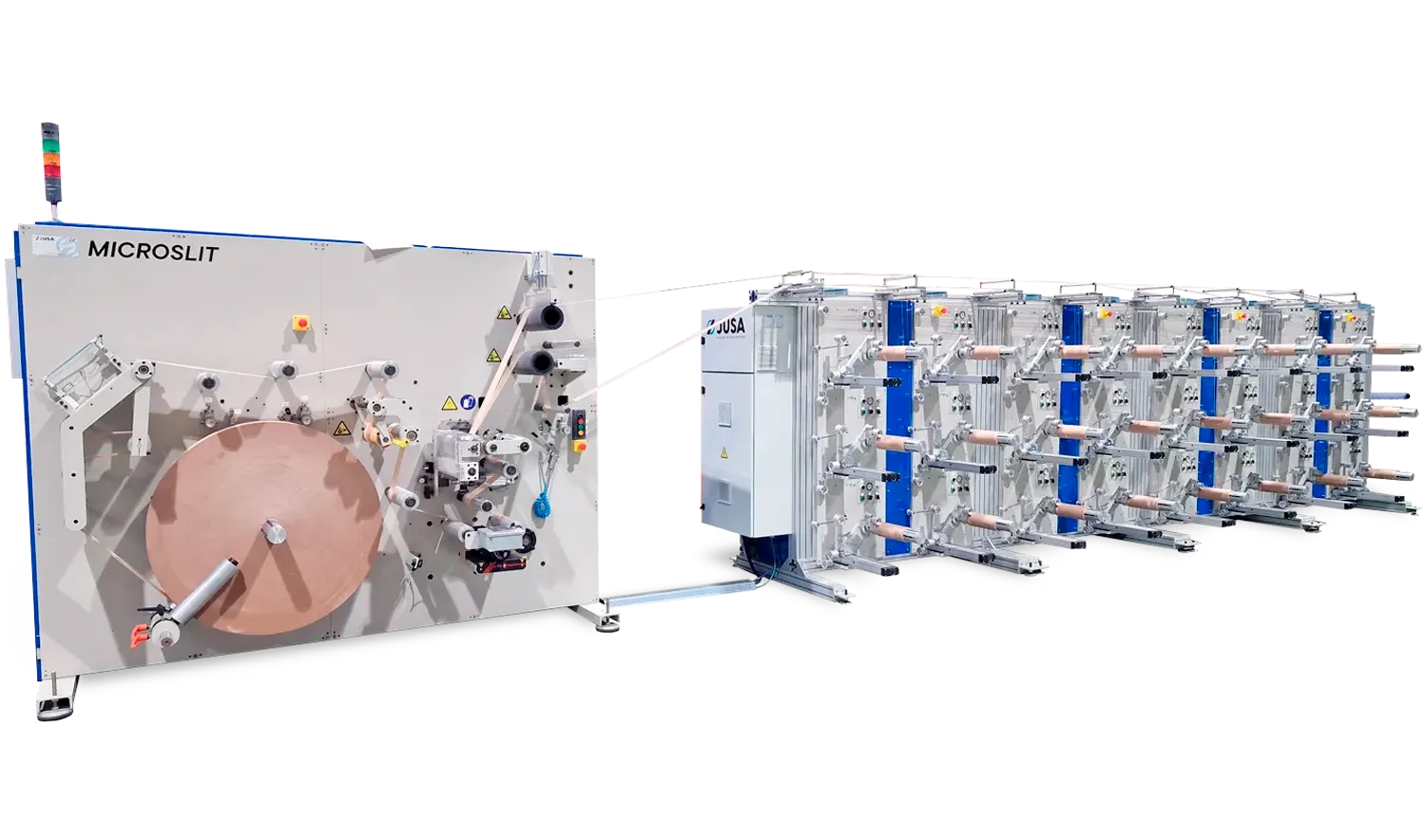

Slitter rewinders are essential machines in the converting of materials supplied in roll form. Their main function is to unwind a parent roll and rewind the material into several narrower rolls, adapted to the requirements of each production process.
One of the main characteristics that distinguishes different slitter rewinders is the system used to form the rolls during rewinding.
Depending on how the force required to wind the material is transmitted, three main systems can be identified:
-
Center or axial winding.
-
Surface or tangential winding.
-
Combined center-surface winding.
Each system has specific characteristics and may be more suitable for certain materials, roll diameters and quality requirements.
Choosing the right winding system is therefore essential to produce stable, uniform rolls with the required hardness.
How Does Rewinding Work?
During the rewinding process, the material travels from the parent roll to the different cores on which the new rolls are formed.
As the material is wound, the diameter of each roll gradually increases. This changes the mechanical conditions of the process and requires parameters such as rotational speed, drive torque, web tension and, depending on the system, the pressure applied to the roll to be adjusted.
The objective is to maintain stable winding conditions throughout the entire cycle and produce finished rolls with the required geometry, tension and hardness.
The main difference between winding systems lies precisely in how the force required to form the roll is transmitted.
Types of Winding Systems
1. Center or Axial Winding
In axial winding, also known as center winding, the movement required to form the roll is transmitted mainly through the shaft or mandrel on which the material is wound.
The rewinding shaft is driven and transmits torque directly to the core. The control system adjusts speed and torque as the roll diameter increases.
This system provides precise control over roll formation and is a highly versatile solution for different materials.
What Is It Used For?
Center winding can be used in a wide range of applications, including:
-
Plastic films.
-
Multilayer films.
-
Laminates.
-
Flexible packaging materials.
-
Paper.
-
Aluminum foil.
-
Adhesive materials.
-
Technical materials.
The specific machine configuration must be adapted to the characteristics of the material and the dimensions of the finished rolls.
Main Advantages
Its main advantages include:
-
Direct control of the torque applied to the roll.
-
Effective tension control during rewinding.
-
Adaptability to different materials and formats.
-
Ability to control roll hardness.
-
Wide range of drive configurations.
Differential Shafts
When several rolls are wound simultaneously on the same shaft, small thickness variations may occur between the different material strips.
These differences can cause some rolls to reach slightly different diameters.
Differential shafts compensate for these variations, allowing each roll to adapt to its own diameter during rewinding.
This solution is particularly useful in certain narrow web applications and processes where uniform roll formation is essential.
2. Surface or Tangential Winding
Tangential winding, also known as surface winding, uses one or more motorized rollers to transmit motion to the outer surface of the roll.
Unlike center winding, where the main drive force is transmitted through the central shaft, surface winding transmits force primarily through contact between the roller and the roll.
The pressure applied to the roll surface and the roller speed are therefore important parameters for controlling roll formation.
What Is It Used For?
Surface winding can be particularly suitable for certain applications involving:
-
Paper.
-
Cardboard and cellulose-based materials.
-
Nonwoven materials.
-
Technical materials.
-
Large-diameter rolls.
The choice depends on the characteristics of the material and the required roll quality.
For materials sensitive to pressure or surface marking, the system configuration must be carefully evaluated.
Main Advantages
-
Motion transmission through the roll surface.
-
Ability to control roll compactness through contact pressure.
-
Suitability for certain large-diameter winding applications.
-
Flexibility to adjust winding conditions for different materials.
Contact pressure must be properly regulated. Excessive pressure can cause overly tight winding or deformation, while insufficient pressure may make it difficult to form a stable roll.
3. Combined Center-Surface Winding
Combined center-surface winding integrates the principles of center winding and surface winding.
The roll is driven through the central shaft and simultaneously by one or more elements acting on its outer surface.
Combining both systems provides greater possibilities for adjustment during roll formation.
The center drive controls the torque transmitted through the shaft, while the surface winding system can provide additional control over roll compactness and contact conditions.
What Is It Used For?
This system can be particularly useful in processes requiring precise control over the characteristics of the finished roll, including:
-
Technical films.
-
Multilayer materials.
-
Laminates.
-
Paper.
-
Technical materials.
-
Large-diameter rolls.
-
Applications with demanding roll hardness and stability requirements.
Its greater control flexibility can be beneficial when a single winding principle cannot achieve the required winding conditions.
Main Advantages
-
Combines center and surface drive systems.
-
Allows control of torque transmitted through the shaft.
-
Enables regulation of pressure applied to the roll surface.
-
Provides greater flexibility in controlling roll compactness.
-
Can be adapted to demanding winding applications.
However, this increased level of control also involves greater mechanical and control system complexity. For this reason, a combined winding system is not always necessary.
Which Winding System Is Most Suitable?
There is no universal winding system suitable for every material.
The choice mainly depends on:
-
Material type.
-
Material thickness.
-
Roll width.
-
Unwinding and rewinding diameters.
-
Number of rolls wound simultaneously.
-
Production speed.
-
Required web tension.
-
Roll hardness.
-
Core characteristics.
-
Level of automation.
In general, center winding offers a highly versatile solution when direct control of the torque transmitted through the shaft is required.
Surface winding can be particularly useful when the roll surface is used to transmit motion and control compactness.
Combined center-surface winding integrates both approaches and may be suitable when the process requires more comprehensive control over roll formation.
The final selection must always take into account the specific characteristics of the material and the finished product.
The Importance of Tension Control
Regardless of the winding system used, tension control is one of the most important factors during rewinding.
Excessive tension can cause stretching, deformation or dimensional variations, particularly in sensitive materials.
Conversely, insufficient tension can lead to wrinkles, layer displacement or unstable rolls.
For this reason, the control system must maintain tension within the appropriate range throughout the process, adapting to the diameter changes that occur as the roll is formed.
Roll Hardness
In addition to tension, roll hardness or compactness must also be controlled.
A roll that is too soft may become deformed during handling, storage or transportation.
An excessively hard roll may cause problems with sensitive materials or make certain downstream processes more difficult.
The winding system must allow these parameters to be adjusted according to the characteristics of the material and the requirements of the end customer.
Roll Diameter and Productivity
The diameter of the finished rolls also influences the selection of the winding system.
As the roll diameter increases, the operating conditions change and the control parameters must be adjusted accordingly.
Furthermore, the productivity of a slitter rewinder does not depend solely on its maximum operating speed.
Other factors must also be considered:
-
Parent roll loading time.
-
Core preparation.
-
Format changeovers.
-
Finished roll unloading.
-
Setup and adjustment times.
-
Roll changes.
-
Production downtime.
Therefore, when comparing different machines, it is more useful to analyze actual production output rather than focusing exclusively on the maximum speed, expressed in meters per minute.
Rewinding Automation
The level of automation must also be adapted to production requirements.
Depending on the machine configuration, different systems can be incorporated for:
-
Automatic tension control.
-
Roll diameter monitoring and control.
-
Automatic parameter adjustment.
-
Automatic positioning.
-
Automatic roll changes.
-
Dual-turret systems.
-
Automatic unloading.
-
Production recipe management.
Greater automation can reduce unproductive time and improve process repeatability, particularly when frequent format changes are required.
However, the level of automation should be determined according to actual production volumes to avoid unnecessarily high investment costs.
How to Choose a Slitter Rewinder
Before selecting a machine, it is important to analyze the material, input and output formats, and production objectives together.
The main technical information required by the manufacturer includes:
-
Material type.
-
Material thickness.
-
Maximum parent roll width.
-
Finished roll widths.
-
Maximum unwinding diameter.
-
Final rewinding diameter.
-
Number of rolls wound simultaneously.
-
Production speed.
-
Required tension and roll hardness.
-
Core dimensions.
-
Required level of automation.
Based on these parameters, it is possible to determine the most suitable winding system and the mechanical and control configuration required for the machine.
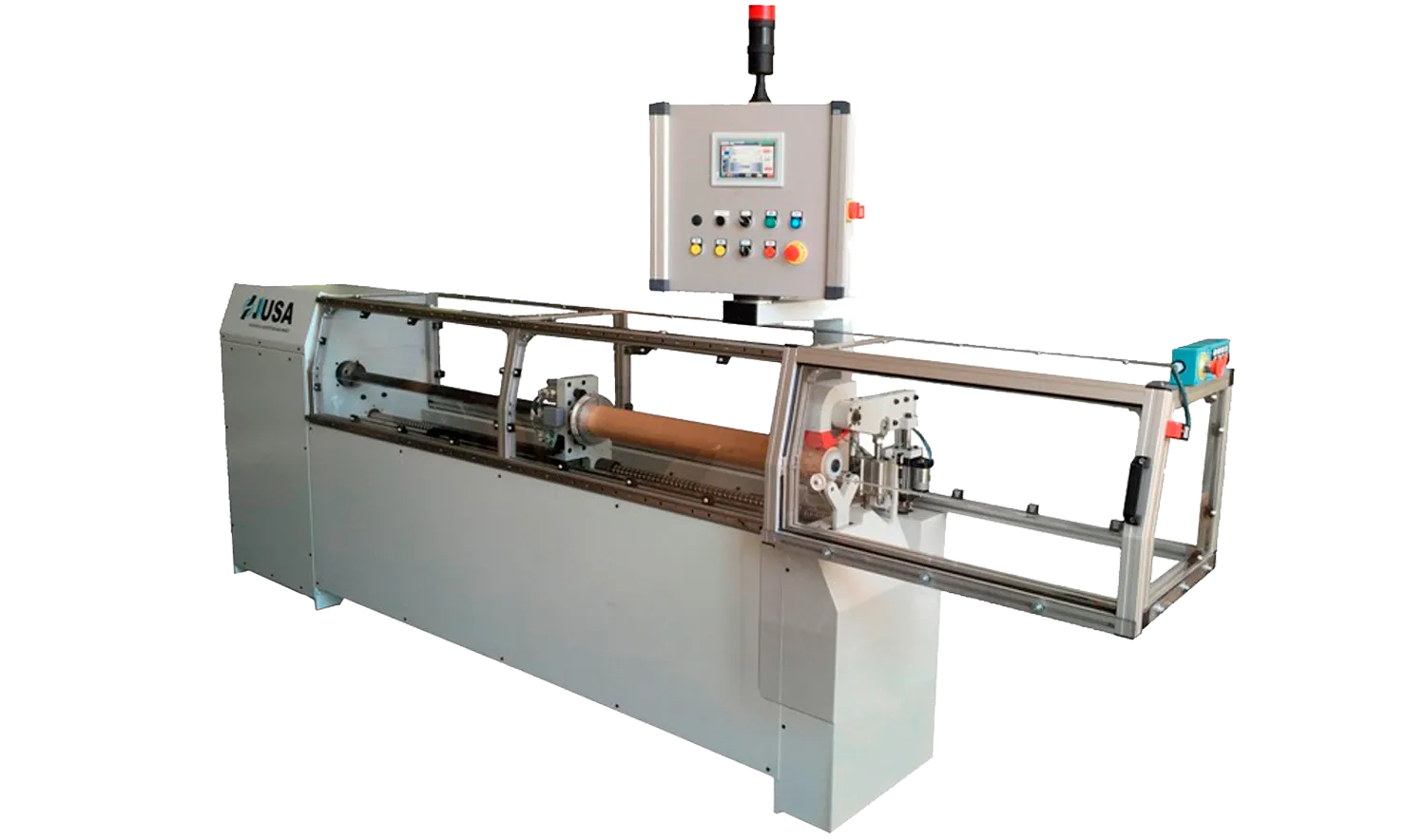
When the production process also requires preparing cardboard cores in different sizes, the production line can be complemented with core cutting machines to maintain a continuous supply of cores ready for production.
Avoid Choosing an Oversized Machine
A slitter rewinder should be configured according to actual production requirements.
A machine with capabilities significantly beyond those required may unnecessarily increase the initial investment, equipment complexity and maintenance costs.
On the other hand, a machine with insufficient capacity may limit future production growth.
The most suitable solution should achieve a balance between:
-
Initial investment.
-
Productivity.
-
Flexibility.
-
Automation.
-
Finished roll quality.
-
Future expansion possibilities.
To define these parameters correctly, it can be useful to carry out a preliminary assessment of the material, formats, production volumes and future objectives of the line through industrial consulting services.
A Winding Configuration for Every Process
The winding system has a direct influence on how rolls are formed and how the process is controlled.
-
Center winding uses the central shaft to transmit motion and provides a versatile solution for numerous applications.
-
Surface winding uses the outer surface of the roll to transmit motion and allows roll formation to be controlled through contact and pressure.
-
Combined center-surface winding integrates both principles, offering greater adjustment possibilities when required by the production process.
The right choice will always depend on the material, roll diameters, tension, required hardness, productivity and level of automation.
Analyzing these factors before defining the machine configuration makes it possible to design a slitter rewinder tailored to the process, improve production stability and obtain more uniform, higher-quality finished rolls.
Frequently Asked Questions About Winding Systems
What Is a Center Winder?
A center winder is a machine in which the motion required to form the roll is transmitted mainly through the central shaft or mandrel. This allows direct control of the torque applied during rewinding.
What Is a Surface Winder?
A surface winder is a machine in which motion is transmitted mainly through contact between a roller and the outer surface of the roll. Contact pressure is one of the parameters used to control roll formation.
What Is a Combined Center-Surface Winder?
A combined center-surface winder integrates a central shaft drive with a surface drive system. It allows simultaneous control of the torque transmitted through the shaft and the force applied to the outer surface of the roll.
Which Winding System Is Best?
There is no single winding system that is best for every application. The choice depends on the material, roll diameters, tension, required hardness and production conditions.
What Are Differential Shafts Used For?
Differential shafts compensate for small diameter differences between rolls being wound simultaneously on the same shaft, helping achieve more uniform rewinding.
Why Is Roll Hardness Control Important?
Because a roll that is too soft may become deformed during handling or transportation, while an excessively hard roll may cause problems in downstream processes or when handling sensitive materials.
Does Maximum Speed Determine Productivity?
No. Actual productivity also depends on loading and unloading times, format changeovers, machine adjustments and other operations performed during the production cycle.
What Information Does a Manufacturer Need to Specify a Slitter Rewinder?
The main information required includes material type, thickness, parent roll width and diameter, finished roll dimensions, number of rolls wound simultaneously, production speed, tension, required roll hardness, core dimensions and the desired level of automation.