

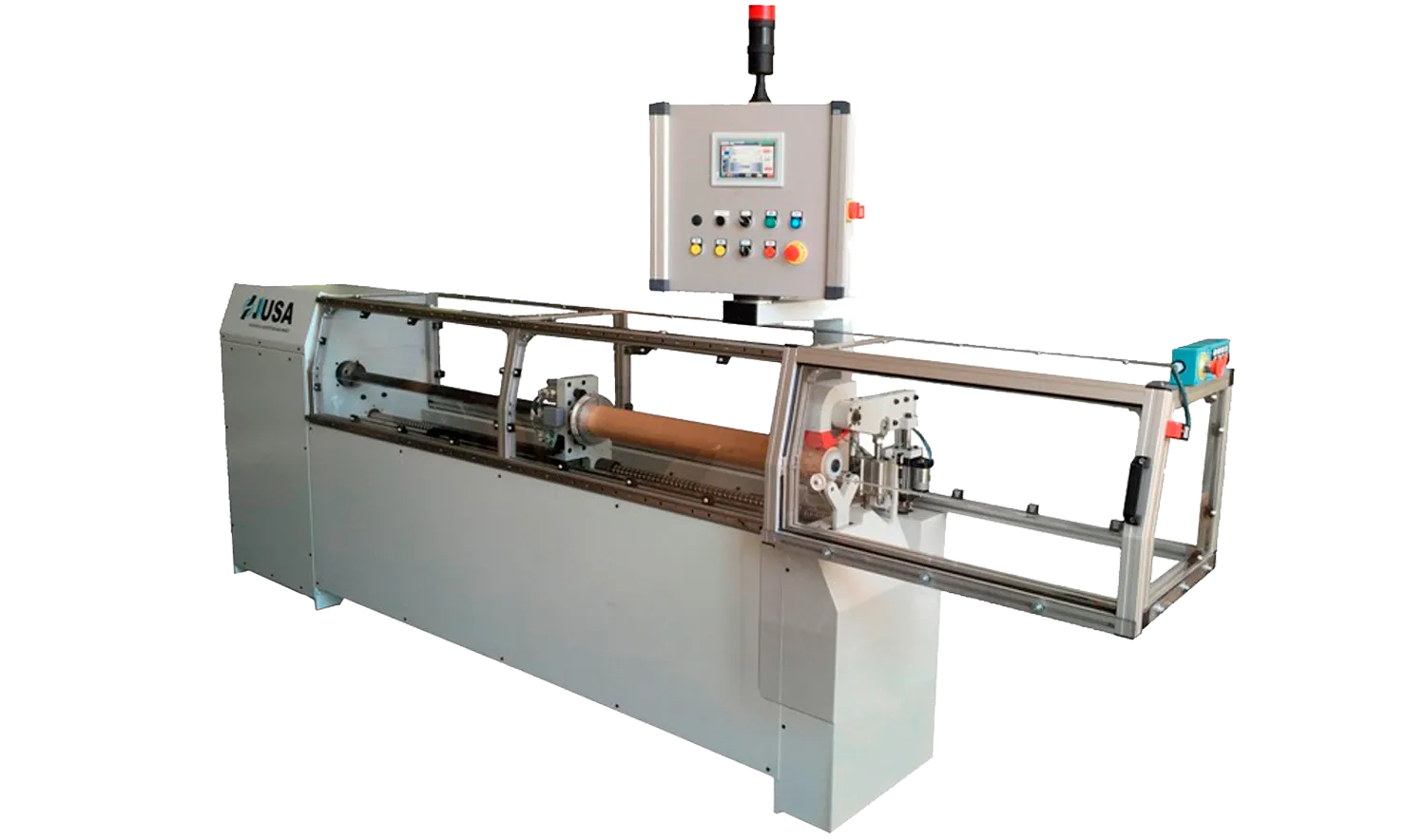
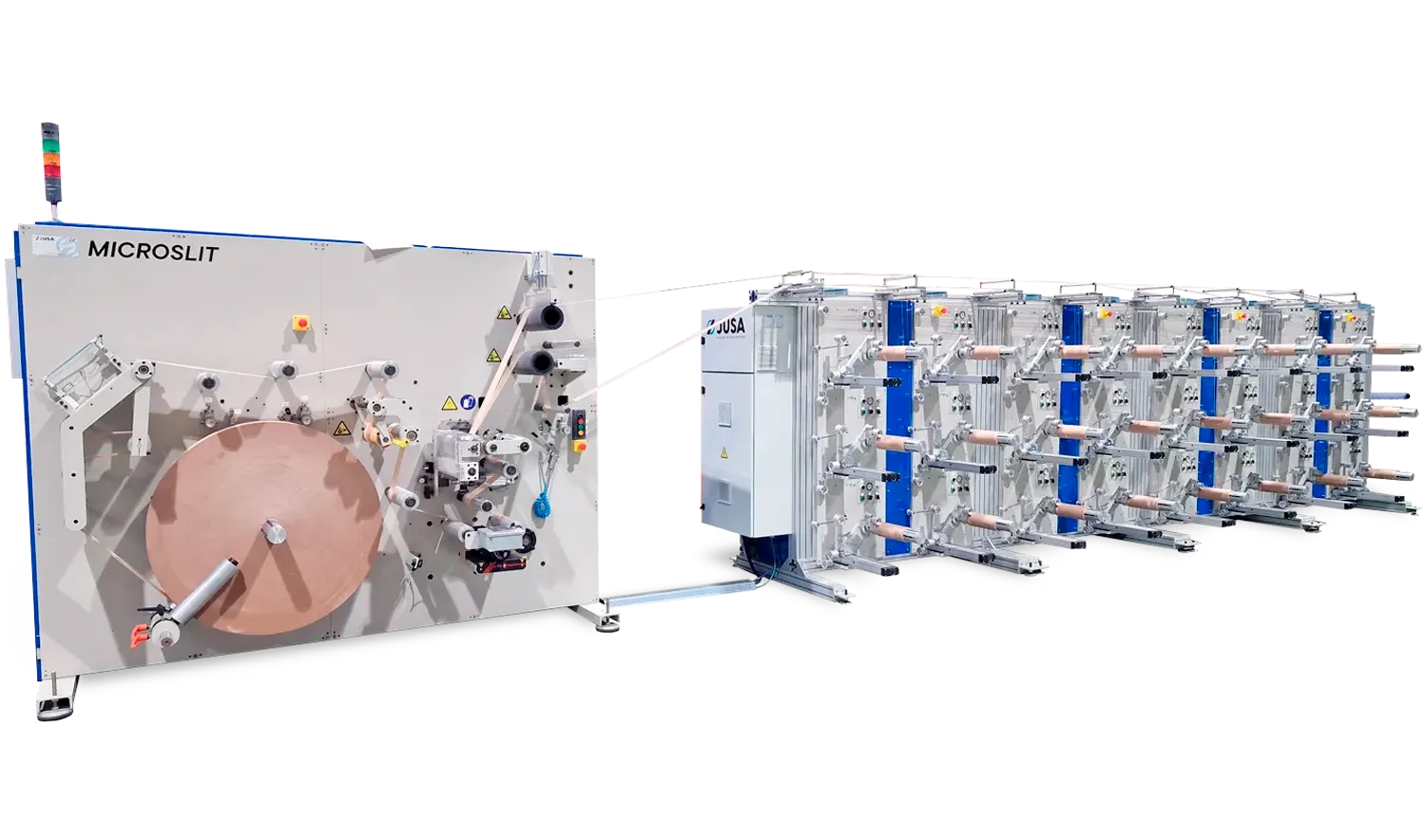

A forwarder is an industrial machine designed to wind continuous material onto a spool, core or mandrel in a controlled and orderly manner, producing a finished spool.
Unlike a conventional rewinder, which typically converts one roll into another, a forwarder is specifically designed to collect continuous material and distribute it transversely across a spool.
The material is wound as the spool rotates, while a relative transverse movement takes place between the material and the spool. Combining these two movements ensures uniform winding and makes full use of the available spool width.
Forwarders are used to produce spools of many continuous products, including cables, wires, adhesive tapes, packaging materials, films, fibers, technical textiles and other industrial products.
What Is a Spool?
A spool consists of a core and, typically, two side flanges between which continuous material is wound.
The objective is to create a compact format that allows a specific length of material to be stored, transported and subsequently used in a controlled manner.
Depending on the application, the core may be made of cardboard, plastic, wood or metal, while its dimensions are adapted to the product and the quantity of material it needs to hold.
The winding must be sufficiently uniform and stable to ensure that the material can later be unwound without shifting, tangling or damage.
How Does a Forwarder Work?
The operating principle of a forwarder is straightforward, although it requires precise coordination between several movements.
Continuous material reaches the winding station and is fed onto the spool. As the spool rotates, the material moves transversely from side to side.
When the material reaches one end of the spool, it reverses direction and continues forming successive layers. This distributes the product evenly across the usable width of the spool.
To achieve high-quality winding, the machine must primarily synchronize:
-
Spool rotational speed.
-
Transverse movement.
-
Material feed speed.
-
Winding tension.
-
Increasing spool diameter.
-
Length of material to be wound.
The relationship between spool rotation and transverse movement determines the traverse pitch and, consequently, how the material is distributed across the spool.
Two Types of Forwarders
Forwarders can be classified according to several criteria, including which component performs the transverse movement.
1. Forwarders with a Moving Material Guide
In this type of machine, the spool remains in a fixed position while a material guide or traverse arm moves transversely.
The guide directs the material from one side of the spool to the other, controlling its position during winding.
The transverse movement is synchronized with the spool’s rotational speed to achieve the required winding pitch and pattern.
This system makes it easy to adapt the traverse movement to different spool widths and formats.
2. Forwarders with a Moving Spool
In this configuration, the incoming material guide can remain stationary while the spool, mandrel or entire winding assembly moves transversely.
The operating principle remains the same: there must be relative movement between the material and the spool to distribute the product across its full width.
Choosing between these configurations depends on factors such as material type, spool width and weight, production speed and the specific requirements of the application.
Mechanical and Electronic Forwarders
Forwarders can also be distinguished by the technology used to control transverse movement and synchronize it with spool rotation.
1. Mechanical Forwarders
Traditional machines used mechanical mechanisms to establish the relationship between spool rotation and transverse movement.
Gears, cams, lead screws and other transmission components were used to control the winding pitch.
This system can be suitable for applications involving long production runs of the same product with few format changes.
However, modifying the winding width, pitch or pattern may require mechanical adjustments or component replacements.
2. Electronic Forwarders
Advances in electric drives and control systems have enabled the development of electronic forwarders, in which movements are synchronized through motors and programmable control systems.
This technology offers greater flexibility and allows winding parameters to be modified directly through the control system without requiring mechanical changes.
Its main capabilities include:
-
Programmable winding pitch.
-
Precise control of transverse movement.
-
Electronic synchronization between different drives.
-
Tension control.
-
Storage of different spool configurations.
-
Rapid changeovers between products.
-
Automation of different stages of the process.
For these reasons, although mechanical solutions can still be found in highly specific applications, electronic technology has progressively become the preferred solution in modern industrial forwarders.
Which Industries Use Forwarders?
Forwarders are used in processes where continuous material needs to be converted into a compact spool ready for handling or subsequent use.
Cable Industry
Cable manufacturing is one of the most common applications.
Forwarders can produce spools of:
-
Electrical cables.
-
Data cables.
-
Telecommunications cables.
-
Coaxial cables.
-
Fiber optic cables.
-
Wires and conductors.
-
Specialty cables.
The spool makes it possible to store and transport long lengths of material while facilitating its subsequent feeding into other processes.
Adhesive Tape Manufacturing
Adhesive tapes are another important application of forwarder technology.
Adhesive materials can be traverse-wound to produce long-length spools intended for subsequent cutting, application or assembly processes.
Applications include single-sided tapes, double-sided tapes, foam tapes and various types of technical adhesive tapes.
Packaging and Converting
In the packaging and converting industry, forwarders can process different flexible materials and narrow-width products.
Some applications include:
-
Plastic films.
-
Paper.
-
Aluminum foil.
-
Laminates.
-
Self-adhesive materials.
-
Tapes and strips.
-
Technical packaging materials.
The spool format enables these products to be continuously fed into different machines and production lines.
Automotive Industry
The automotive industry uses numerous adhesive tapes and technical materials supplied on spools.
These products are used in assembly, fastening, insulation and component protection processes.
The spool format facilitates continuous material feeding into automated machinery and assembly operations.
Other Industrial Applications
Forwarder technology can also be used in other industries, including:
-
Textile manufacturing.
-
Nonwoven fabrics.
-
Fiberglass.
-
Fiber optics.
-
Electronics.
-
Composite materials.
-
Filaments.
-
Technical tapes.
-
Wires.
-
Narrow-width industrial materials.
In each case, the machine configuration must be adapted to the characteristics of the product and the spool being manufactured.
The Importance of Tension Control
Tension control is one of the most important factors in producing a high-quality spool.
Insufficient tension can result in loose and unstable winding, while excessive tension can deform, stretch or even damage certain materials.
Furthermore, winding conditions change as the spool diameter increases. For this reason, tension and speed must be controlled throughout the entire winding cycle.
Depending on the application, a forwarder may incorporate different regulation systems using motors, brakes, load cells, dancer rollers or other control technologies.
What Is the Difference Between a Forwarder and a Rewinder?
Although both machines perform winding operations, they serve different purposes.
A conventional rewinder typically starts with an existing roll and converts it into one or more new rolls, modifying their width, diameter or length.
A forwarder, on the other hand, is primarily designed to collect continuous material and form a spool through traverse winding.
For example, a manufacturing line may produce a continuous strip of tape that is subsequently collected by a forwarder to form spools of a specific length and diameter.
What Factors Should You Consider When Choosing a Forwarder?
The configuration of a forwarder mainly depends on the product being wound and the characteristics of the finished spool.
The most important factors include:
-
Material type.
-
Material width and thickness.
-
Elasticity and rigidity.
-
Allowable winding tension.
-
Spool diameter and width.
-
Required material length.
-
Production speed.
-
Core type and dimensions.
-
Spool weight.
-
Required level of automation.
These parameters help determine the most appropriate traverse system, drive configuration, tension control system and degree of automation.
A Machine Designed to Produce High-Quality Spools
A forwarder is much more than a machine that simply winds material. Its purpose is to transform a continuous product into a compact, uniform and stable spool that can be efficiently used in subsequent processes.
The basic principle involves coordinating spool rotation with the transverse movement of the material. However, achieving high-quality winding requires precise control of tension, speed, winding pitch and increasing spool diameter.
Advances in drive and control technologies have made electronic forwarders the most flexible solution for many industrial applications, progressively replacing traditional mechanical systems.
Thanks to this technology, forwarders can accommodate a wide variety of products and industries, from cables and adhesive tapes to packaging, automotive components, technical textiles, fiber optics and other industrial materials.
Ultimately, a forwarder converts continuous material into a precisely wound spool, ready for storage, transportation, feeding or use in subsequent production processes.